Sokoni retail prepares to offload up to two billion existing shares as Kenya’s second-largest supermarket chain tests public capital markets.
By Our Staff Writer
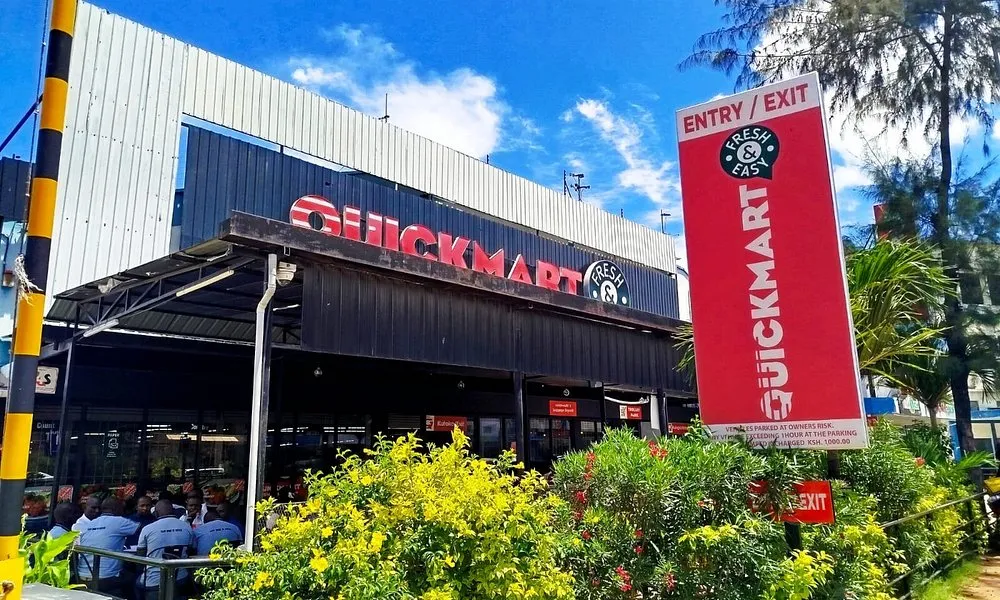
Quickmart is targeting a September 30 launch for its long-awaited listing on the Nairobi Securities Exchange (NSE), setting up what will become one of the most significant consumer-facing flotations on the local bourse in recent years.
The 72-store supermarket chain plans to offer two billion existing ordinary shares through the Main Investment Market Segment, representing 50 per cent of its issued share capital. The transaction, structured entirely as an offer for sale by sole shareholder Sokoni Retail Kenya Limited (SRKL), means the retailer will not raise primary capital from the market. Instead, the multi-billion-shilling exercise is designed to provide an exit route for private equity backers while establishing a public float.
“We have a tentative date of September 30 subject to approval by the regulator,” management told market observers.
The offering includes an over-allotment option of up to 15 per cent of the offer shares. If fully triggered, SRKL’s stake in the business will drop from 100 per cent to approximately 42.5 per cent, effectively transferring up to 57 per cent of the company into public hands. The shares carry a nominal value of KES 0.20 each, translating to KES 400 million in nominal share capital.
Shifting economics and private equity realities
The public float marks a defining maturation phase for a business that began as a single shop in Nakuru in 2006 and accelerated through its 2020 merger with Tumaini Self Service. Behind the expansion sits Sokoni Retail Kenya, an investment vehicle backed by Mauritius-headquartered private equity firm Adenia Partners alongside the supermarket’s founders and Chief Executive Officer Peter Kang’iri.
For Adenia and its co-investors, the NSE listing provides partial liquidity without relinquishing strategic command. By choosing an offer for sale rather than an Initial Public Offering (IPO), the existing owners signal that the retailer’s balance sheet requires no fresh equity injections to fund its footprint.
“Quickmart will not issue any new shares and will not receive any proceeds from the Offer,” the company stated. “The Company expects to continue funding its organic growth and store expansion primarily through internally generated cash flows.”
That self-funding model is supported by robust top-line performance. Quickmart closed fiscal 2025 with KES 50.4 billion in revenue and an adjusted profit after tax of KES 1.7 billion. Between 2021 and 2025, its turnover expanded at a compound annual growth rate of 18.4 per cent, pulling in KES 27.3 billion during the first half of 2026 alone. With a footprint spanning 16 counties, roughly five million monthly customer transactions, and 2.5 million active Q-Points loyalty members, the retailer handles a sizeable share of formal urban consumption.
Betting on dividends in a tight consumer market
To entice institutional and retail investors onto the registry, Quickmart’s board has floated an aggressive capital-return policy. The company intends to target a dividend payout ratio of at least 80 per cent of its annual profit after tax, with distributions scheduled semi-annually.
The promise of high cash distributions comes at an opportune moment for the NSE, which has faced a prolonged drought of major corporate listings and a dearth of liquid retail counters. It also speaks to an underlying commercial reality: as cash-strapped urban households ration discretionary spending amid macroeconomic pressures, formal retailers must rely on aggressive scale, supply-chain efficiency, and steady foot traffic to protect margins.
“The proposed listing marks an important milestone in Quickmart’s journey,” said Mr Kang’iri. “Listing on the NSE will give Kenyans the opportunity to own a share of a business they already shop in, while raising our profile with suppliers and partners as we continue to deliver on our growth strategy.”
Martha Osier, Partner at Adenia Partners, echoed the sentiment of continuity. “The existing shareholder group intends to retain a substantial interest in the company following the Offer, reflecting our continued confidence in the company and its long-term prospects.”
With regulatory clearance from the Capital Markets Authority pending, the coming weeks will reveal whether Nairobi’s public investors are willing to re-price Kenya’s modern retail wars from the comfort of a brokerage account.