Rather than submitting to punitive credit terms, African leaders in Nairobi vow to turn natural resources and collective bargaining into hard leverage against global debt rules.
By Our Reporter
NAIROBI — African states are currently committing $90 billion annually to service public debt, an outlay that outstrips incoming official development assistance and dedicated climate finance combined. Addressing delegates at the sixth African Conference on Debt and Development in Nairobi, Korir Sing’oei, Kenya’s principal secretary for foreign affairs, observed that “Africa pays $90 billion a year in debt service. That is more than aid and climate finance combined.”
Mr Sing’oei stated that $75 billion of that total constitutes an artificial surcharge imposed by foreign capital markets, characterizing the penalty as a “trust tax” levied against the continent. Pointing out that twenty-two African countries are currently classified as being in debt distress or at high risk of default, he argued that the penalty reflects structural bias rather than actual default history. “This Africa risk premium forces an unpleasant choice between servicing expensive debt and investing in health, education and climate resilience of our people,” Mr Sing’oei warned.
Tracing the evolution of the continent’s diplomatic priorities, Mr Sing’oei noted that “in the 1960s, foreign policy on the continent was about political independence and political sovereignty,” but has now shifted squarely to the cost of capital. “If we do not fix from whom we borrow, how we borrow and at what price, we will not have a social contract,” he argued. “We will have a debt contract.”
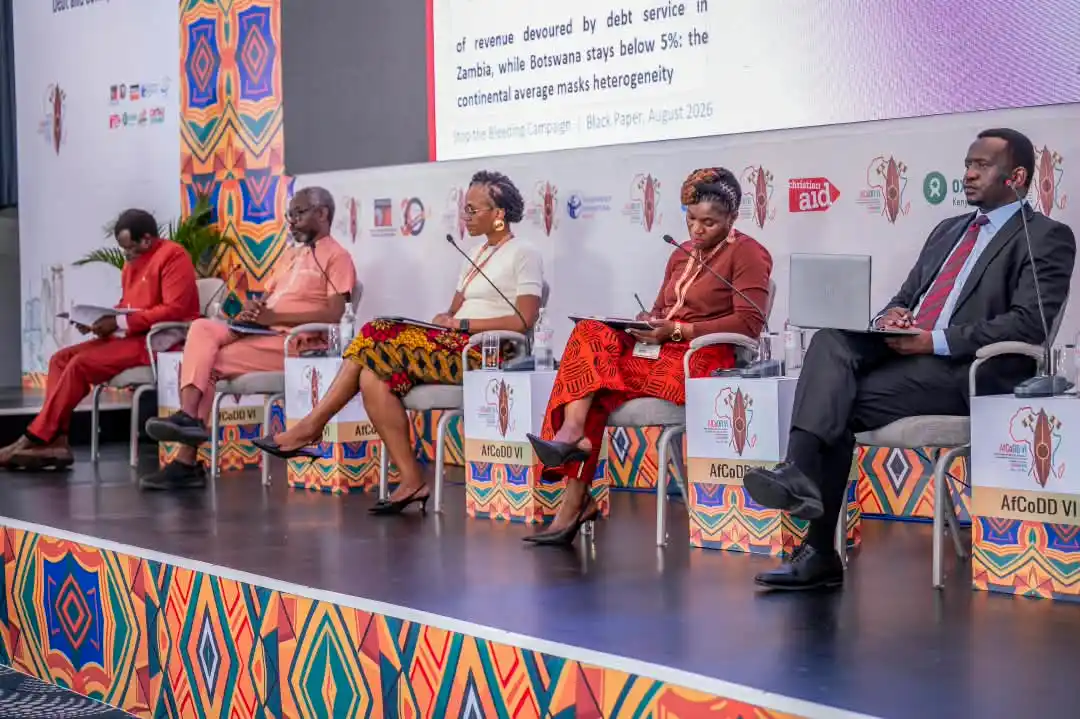
Delegates at the Nairobi conference—organised by the African Forum and Network on Debt and Development (AFRODAD) to mark its 30th anniversary—emphasised that resolving the crisis requires more than pleading for relief on interest rates. During a key panel titled “Deploying the Continent’s Strategic Assets to Rewrite the Rules of International Debt Governance,” experts argued that the debt crisis is compounded by systemic leaks and unexploited strengths. As panel representatives from the Stop the Bleeding Campaign, Tax Justice Network Africa, and the Pan-African Lawyers Union highlighted, Africa must systematically convert its vast mineral reserves, market scale, and technological capacity into direct negotiating power to alter global financial governance.
The structure of sovereign borrowing across the continent has altered dramatically over recent decades. In the 1990s, roughly 70 per cent of African external debt sat with Paris Club lenders, a group dominated by Western bilateral governments. According to figures presented by Kenya’s ministry of foreign affairs, private commercial creditors and bondholders in financial centers like London, Hong Kong, and the Gulf states now hold approximately 40 per cent of total sovereign debt.
This creditor fragmentation has prolonged debt workouts. Delegates noted that Zambia’s sovereign restructuring required four years of complex negotiations among private bondholders, multilateral bodies, and non-Paris Club bilateral creditors, particularly China.
To counter these market pressures, African governments are moving to operationalise the African Common Position on Debt, a unified framework adopted by African Union heads of state in February. Speaking on behalf of the host government, Mr Sing’oei proposed cutting Africa’s borrowing premium by 200 basis points over three to four years, noting that “cutting our borrowing premium by 200 basis points over three to four years would free up $20 billion annually,” which could directly fund the African Union’s Agenda 2063 infrastructure programme.
The plan relies on building regional financial machinery to reclaim credit pricing and reduce reliance on offshore institutions. These initiatives include the African Credit Rating Agency, scheduled to launch in Mauritius in October, and the Alliance of African Multilateral Financial Institutions, a coalition uniting regional lenders such as the African Development Bank and Afreximbank to deepen domestic liquidity.
With Africa requiring an estimated $1.3 trillion annually to meet its Sustainable Development Goals, conference participants stressed that unadjusted commercial borrowing terms will continue to drain domestic revenues. “Without changing how we structure and price debt, sustainable development remains completely out of reach,” delegates cautioned. The proposed policy measures and strategic interventions will undergo further review at the Global Trust Summit in Nairobi this October.