A Nigerian mega-refinery breaks US dominance in European jet fuel markets, exposing the raw mechanics of regional price discovery.
By Our Reporter
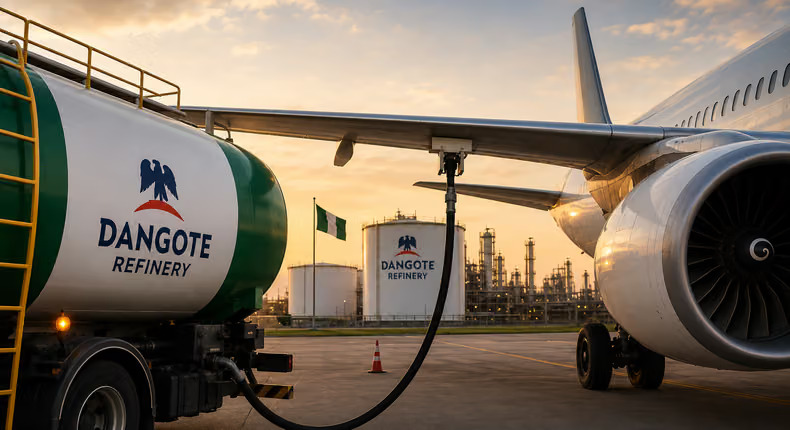
At 466,000 metric tonnes in June (roughly 582.5 million litres valued at ₦757 billion or $553 million), the volume of aviation fuel departing the Lekki peninsula outside Lagos bound for European ports was a notable statistical event. According to Commodities at Sea data from S&P Global Commodity Insights, Aliko Dangote’s $20 billion refining facility doubled its shipments from 232,000 tonnes in May to surpass every exporter on the US Gulf Coast and become Europe’s largest external supplier of jet fuel. Meanwhile, American exports to Europe fell from 560,000 tonnes to 399,000 tonnes over the same period. Subsequent tracking by shipping analytics firm Kpler showed that despite an operational breakdown in early July that trimmed European deliveries back to 400,000 tonnes, the Nigerian plant still captured approximately 20% of Europe’s total jet fuel imports for the month.
Confirming the shift, Dangote refinery chief executive David Bird stated that the facility was Europe’s largest jet-fuel supplier in both June and July. Mr Bird explained that limited local absorption created an immediate export imperative, noting that “limited African demand left the refinery with a surplus that could be sold internationally.”
The export surge occurred even as Northwest Europe jet fuel benchmarks cooled from a record $1,694.25 per metric tonne in March to $981.75 by the end of June under heavy regional supply. A European fuel trader told Platts that strong exports from both the United States and Dangote contributed directly to the oversupplied market. Broader International Energy Agency data shows global refinery throughput fell to roughly 89 million barrels per day in July, leaving a 5 million barrel deficit against global demand and driving US diesel margins past $102 per barrel. The underlying catalyst was severe overseas disruption: the choking of the Strait of Hormuz during the US conflict with Iran, coupled with Ukrainian strikes on Russian refineries, removed substantial Middle Eastern and Russian fuel supplies from international markets.
While American energy giants pushed US distillate exports to a record 1.9 million barrels per day in early August, Mr Dangote’s plant leveraged its Atlantic location and technical capabilities (demonstrating throughput of over 700,000 barrels per day during process performance tests) to capture European market share.
The shift marks a sharp reversal for West Africa’s largest economy. Before the mega-refinery opened in 2024, Nigeria imported virtually all its refined petroleum despite producing roughly 1.8 million barrels of crude oil per day. Yet company executives maintain that domestic commitments remain the top priority. “Provided we continue to get access to Nigerian grades with the support of Nigerian government and NNPC, albeit at internationally benchmarked prices, we will continue to process that oil and serve the domestic market with priority,” a spokesperson for the group stated, adding that there is “uninterrupted supply to the Nigerian economy for all of its refined fuels requirements.”
Local consumers, however, have seen little relief. The global price spike triggered a 39% increase in domestic pump prices, compounding transportation costs across the country. “In the oil and gas downstream sector, recent global developments have once again exposed our vulnerability,” noted one domestic industry observer, pointing out that “the Iran-US-Israel tension triggered a 39% increase in pump price by domestic refineries, the highest globally, further worsening transportation costs and deepening hardship for Nigerians.”
That dynamic is drawing close scrutiny across East Africa. As part of a broader $46 billion investment programme planned between 2026 and 2028 across refining, cement, and fertilizer, Dangote Industries is planning a 700,000-barrel-per-day refinery in Kenya. Combined with the planned expansion of its Nigerian operations to 1.4 million barrels per day, the group aims to establish a 2.1 million-barrel-per-day refining network spanning West and East Africa. Addressing a capital markets forum in Nairobi, David Ndii, chief economic adviser to Kenyan President William Ruto, confirmed that “Kenya could take a 10% stake worth about $500 million,” adding that “the total for the region is about $1.5 billion” as Ethiopia and Rwanda evaluate equity participation. President Ruto stated the proposed facility will “create about 60,000 jobs for Kenyans and supply refined fuel to eight East and Central African countries,” offering a direct buffer for regional markets long reliant on costly refined imports along the Northern Corridor.
As Dangote Industries prepares an initial public offering in Nigeria to raise as much as $5 billion, investors must assess whether this export performance reflects long-term competitiveness or a temporary windfall from geopolitical disruption.
Outshipping American energy giants across the Atlantic proves that African downstream capital can compete on the world stage; convincing local consumers to pay world-market prices without political upheaval will determine whether the empire survives its own success.