The continent that never quite got its manufacturing moment is now being asked to skip a step it hasn’t taken. Nobody has explained how.
By Our Staff Writer
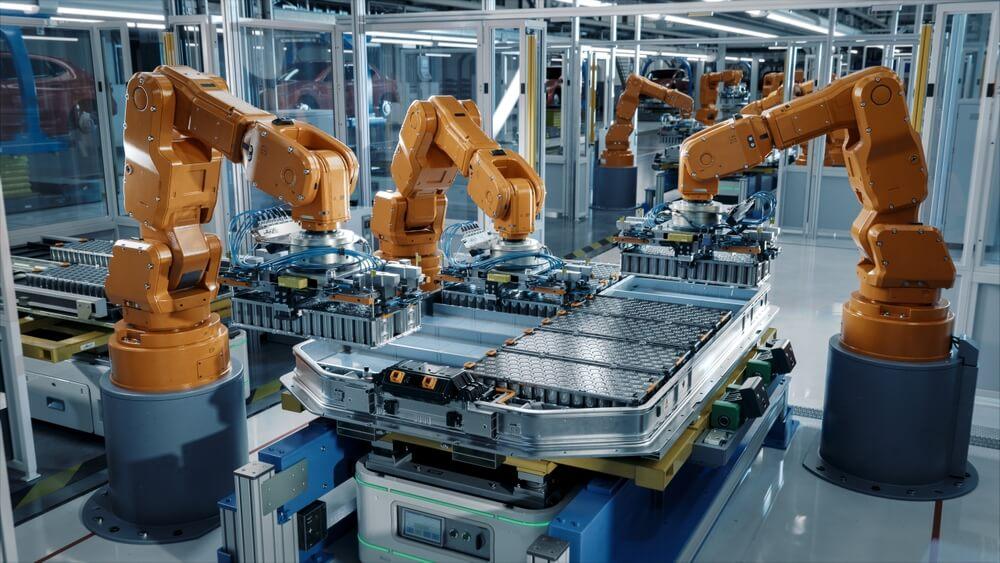
At a robotics fair in Nairobi last year, a demonstration cell folded, packed and sealed forty units of a snack product in the time it took a floor manager to explain what the machine cost. Somewhere behind him, three workers who once did that job by hand stood watching, not participating. The scene is small. The conundrum it poses is not.
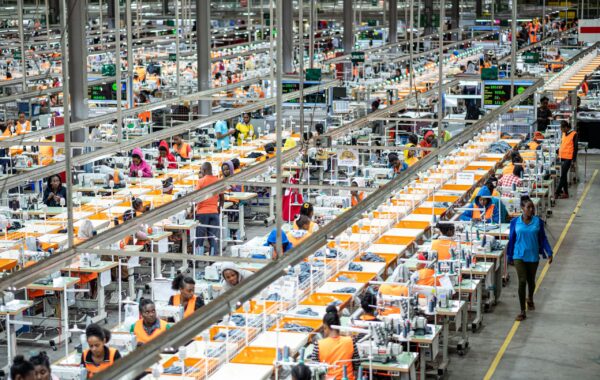
Africa was meant to inherit the low-wage manufacturing that Asia is outgrowing, the same route that lifted Malaysia and then Vietnam. That assumption is looking shakier by the year. Foxconn, the Taiwanese contract manufacturer, has already replaced 30 percent of its workforce with robots at one plant. Adidas built “Speedfactories” in Germany and the United States that use computerised knitting and robotic cutting to make shoes closer to the customer, no Vietnamese seamstress required; the firm’s decision to shutter a Vietnamese plant cost 1,000 jobs there. China, still the workshop of the world, is automating at a pace that makes its own low-wage advantage look temporary, never mind anyone else’s. As Akinwumi Adesina, president of the African Development Bank, put it, China’s investment in robotics means “the flying geese are not coming to Africa.” A tidy metaphor, redolent of a development theory now looking dated. Whether he is right remains, as economists like to say, contested.
The exposure is not evenly spread, and that is the more interesting part of the story. A widely cited World Economic Forum estimate puts the share of work activities susceptible to automation at 41 percent in South Africa, 44 percent in Ethiopia, 46 percent in Nigeria, 48 percent in Mauritius, 52 percent in Kenya and 53 percent in Angola. Kenya sits near the top of that unhappy table, and the labour-market data give the estimate some teeth: 13.9 percent of working-age Kenyans were out of work or long-term unemployed in the final quarter of 2022, with analysts partly attributing the sclerosis to automation already under way in banking and insurance. Manufacturing’s share of Kenyan GDP hovers around 12 percent, well short of the 20 percent threshold economists tend to associate with genuine industrial transformation. Landry Signé, a Brookings fellow who has spent a career on the continent’s political economy, has traced part of the underlying weakness to logistics rather than robots: “the limitations in traffic and trade have effects on industrial development.” Kenya, in other words, may be automating its way out of jobs it never fully created, on infrastructure never quite finished.
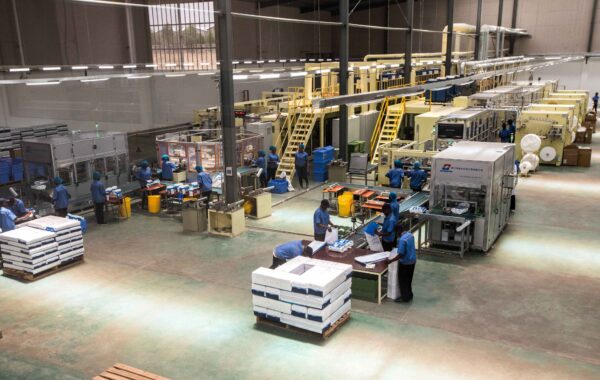
And yet the robots have not actually arrived, not in any quantity that would justify the anxiety. Fewer than 5 percent of manufacturing firms in developing countries use advanced digital production technology; in some, over 70 percent of manufacturers still run on purely analog equipment. Kenya’s own experience bears this out. High interest rates make the multi-year payback period on a robotic line hard to justify against the near-term cost of hiring another worker. Import duties and freight charges push the price of industrial hardware in East Africa well above what a factory in Vietnam or Poland would pay for the identical machine. No meaningful concessional financing exists to bridge the gap. The International Federation of Robotics, whose annual count of installed machines functions as the industry’s closest thing to a scoreboard, notes that adoption among small manufacturers worldwide remains “hampered by high initial investment and total cost of ownership.” Africa barely registers on that scoreboard at all. Which raises the odd possibility that the continent’s problem is not too much automation but too little industry, full stop, automated or otherwise.
Governments, predictably, have responded with paper. Kenya’s Ministry of Information, Communications, and Digital Economy unveiled a National AI Strategy for 2025 to 2030 at a ceremony in Nairobi last March, positioning the country as the continent’s AI hub of choice (a title several other capitals also claim, chary as they are of missing out). Strategy documents are, of course, easier to produce than concessional loans for capital equipment. Andrew Dabalen, the World Bank’s chief economist for the Africa region, frames the constraint at a level above any single country’s policy paper: global “growth in the world has actually been declining and has been relatively tepid,” and job creation follows growth, not the other way round.
There is a case, unfashionable as it sounds, that the alarm is somewhat overwrought. The Tony Blair Institute, surveying Africa’s more advanced manufacturing plants, found that new production technology is “not leading to net job losses” there; the firms adopting it are growing and hiring even as individual tasks are automated away. The technology being installed, on this reading, targets tasks that under-connected machines were already performing badly, not human labour that was thriving. Global evidence on the net effect is genuinely mixed. Oxford Economics has calculated that each new industrial robot wipes out 1.6 manufacturing jobs, with the least-skilled regions bearing the brunt disproportionately, yet the same analysis concedes that automation’s productivity gains tend to generate roughly as many jobs elsewhere as they destroy. Whether Africa captures that offsetting growth, or merely absorbs the losses while the gains accrue to shareholders in Shenzhen and Stuttgart, is precisely the question nobody can yet answer with any confidence.
What would tip the balance toward the optimistic case is not mysterious, even if assembling it is proving hard going. Cheaper, more reliable power would lower the cost of running automated lines in the first place, an unglamorous precondition that gets far less attention than AI strategy launches. Technical and vocational training pipelines, chronically underfunded across the region, would need to produce robotics technicians and maintenance engineers faster than universities currently manage. And financing structures calibrated to African interest-rate realities, rather than imported wholesale from Frankfurt or Washington, would need to exist at a scale that, at present, they do not.
None of this guarantees an outcome either way. Africa’s demographic arithmetic, a working-age population still expanding for decades to come, makes the stakes of getting the sequencing wrong unusually severe; there is little precedent for automating a manufacturing sector before it has been built. The continent may yet leapfrog the assembly-line phase of development altogether, moving straight into digitally enabled services, as some policymakers now quietly hope. Or it may simply arrive at the automation problem before it ever gets the industrialisation prize meant to precede it, gouged by a technology it barely uses but somehow still competes against. Which of those futures obtains will not be decided by strategy documents, however handsomely bound, but by the price of a robot arm relative to the price of a worker’s monthly wage, and by whether anyone with capital is prepared to bet on the latter for a while longer.