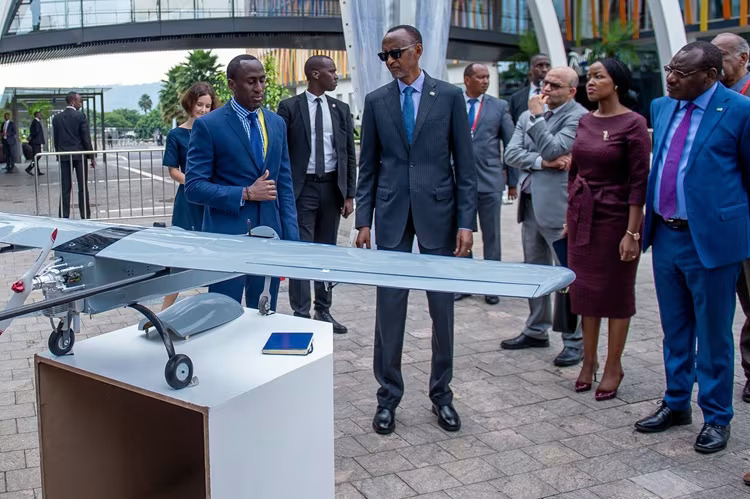
A drone summit and a private-jet executive are, it turns out, making the same case.
By Napoleon Mugenzi
Two days before the drones themselves take to the air, Africa’s civil aviation chiefs will shut the door on everyone else. That is the point. The inaugural African Drone Regulators Forum, arriving at Nairobi’s Sarit Expo Centre on September 9th and 10th as a new fixture of Aviation Africa’s tenth edition, gathers officials from across the continent’s fractured regulatory map to compare notes on a technology that has, for years, outpaced the paperwork meant to govern it. One floor up, in spirit if not literally, a rather different aircraft executive is making a structurally identical argument about a much larger machine.
The forum’s return as strategic partner for Aviation Africa’s Drone and Autonomous Systems Programme is, on paper, a scheduling footnote. In practice it is an admission. Drone policy across Africa has developed the way most African infrastructure develops: unevenly, nation by nation, with Kenya’s rules bearing little resemblance to Nigeria’s, and Nigeria’s bearing less still to Rwanda’s. A closed-door session for regulators only is not a snub to industry; it is a concession that the industry’s growth has been outrunning the licensing regimes meant to contain it.
The programme’s public face is louder. An African Drone Security Forum will run on September 9th, the summit’s opening day, pairing drones with artificial intelligence and asking, not always comfortably, what happens when detection and response systems meant to police the skies fall into the wrong hands. The Regulators Forum itself, closed to all but civil aviation officials, follows on September 10th. Five further panels will take up workforce training, beyond-visual-line-of-sight operations, drone data, advanced air mobility and, the perennial sticking point, investment. (Investors, one suspects, will do more listening than pledging.)
Eno Umoh, the forum’s founding chair, frames the shift in suitably expansive terms. “These conversations now extend beyond technology and regulation to airspace integration, security, infrastructure, investment and operational readiness,” he says.
“Bringing those stakeholders together creates an important opportunity to look at how autonomous aviation can be integrated safely, responsibly and sustainably across Africa.” Sceptics might note that African aviation summits have a long history of promising integration and delivering pilot schemes. But the emphasis this year on what comes after regulatory approval, corridor design, remote identification, coordination with air navigation service providers, suggests organisers have absorbed the continent’s real conundrum: it is not the absence of rules that stalls drone commerce in Africa, but the absence of infrastructure to make the rules matter.
That same issue, scaled up considerably, is the subject of Simon Budden’s contribution to this year’s programme. Budden, senior vice-president at Vista Global (parent of VistaJet), will join a business and general aviation symposium running alongside the drone track across the same two days, and his written brief for the event makes the connectivity argument in blunter terms than any regulator has managed.
“Africa has never lacked ambition,” he writes. “What it has often lacked is the connectivity to match it.” Business aviation, in his account, is routinely “misunderstood as a luxury” when in practice, given how thin scheduled routes remain between neighbouring African states, it functions as “essential infrastructure”: filling gaps commercial carriers cannot reach with the frequency modern trade requires.
Budden’s case is more commercial than regulatory, but it is redolent of the same underlying complaint driving the drone forum; rules and routes exist on paper, the machinery to use them, less so. “When executives spend days reaching customers, suppliers or investment opportunities, growth slows,” he argues, framing private aviation as the practical stopgap for a free-trade area, AfCFTA, whose promise still outruns its plumbing. Vista’s own numbers back the pitch: a fleet including multiple Challenger 605s now dedicated to the region, alongside continuing demand for Global 6000 and Global 7500 aircraft, part of what Budden calls more than fifteen years of “long-term strategy” on the continent.
Scale, hitherto the drone industry’s stated ambition, remains chary of the numbers. Aviation Africa’s 2025 edition drew upward of 2,100 delegates and 120 exhibitors, respectable, if a reminder of how much runway both drones and business jets still have to cover before either counts as ordinary infrastructure rather than a workaround. Whether Nairobi’s September 9th to 10th gathering turns two years of parallel argument, one aimed at the regulators, one at the boardroom, into anything resembling a single continental connectivity strategy is the thread nobody at Sarit Expo will be able to answer this year. What is harder to dispute is that both sides of the industry have, independently, arrived at the same diagnosis.