Climate policy is colliding with a harder arithmetic: feed a growing population, protect fragile incomes and reduce the gases coming from the farm. Kenya has little room for error.
By Our Staff Writer
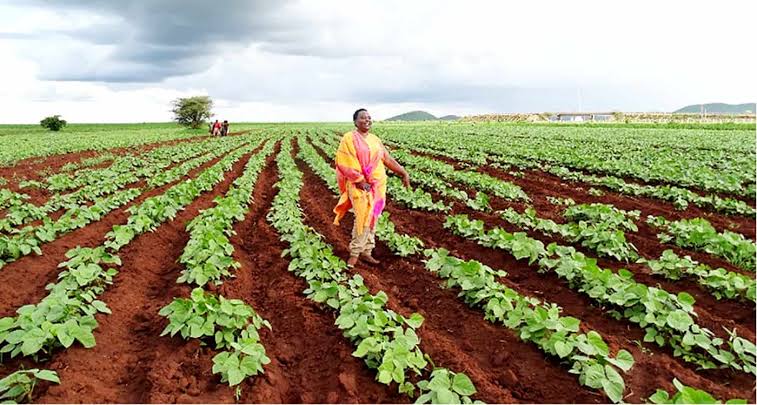
In a Kenyan maize field, the climate debate can seem almost absurdly distant. The farmer is watching the clouds, checking the price of fertiliser and wondering whether the rains will arrive on time. Somewhere else, an emissions target is being calculated.
Both are about the same thing.
Agriculture sits awkwardly at the centre of Africa’s climate conundrum. It is a source of greenhouse gases, particularly methane and nitrous oxide, yet it is also one of the sectors most exposed to rising temperatures, erratic rainfall and extreme weather. Trying to make it greener without making food scarcer or farmers poorer is the trick.
There is no tidy version.
Kenya’s agricultural sector directly contributes about 24% of GDP and provides livelihoods, directly or indirectly, for roughly 72% of the population, according to the Kenya National Bureau of Statistics. The stakes are consequently larger than the carbon balance of individual farms. Agriculture is employment policy, food policy, rural policy and, increasingly, climate policy in disguise.
The first mistake would be to treat African farmers as the principal villains of global warming.
They are not.
Much of African agriculture remains small-scale and rain-fed. The African Development Bank says that less than 10% of Africa’s cultivated land is irrigated, while cereal yields in East Africa are about 2 tonnes per hectare, compared with 4.7 tonnes in south-east Asia. The productivity gap is enormous; so is the opportunity to close it.
The methane problem is only half the story
Livestock attracts much of the attention because cattle and other ruminants emit methane. Fertiliser presents another problem: nitrogen not absorbed by crops can escape as nitrous oxide, a potent greenhouse gas.
That does not make the cow an enemy.
A farmer in Kenya does not keep cattle merely to emit methane. Livestock provide milk, meat, manure, savings and, in many communities, a form of household insurance. Removing animals without replacing those economic functions could reduce one environmental pressure while creating several others.
The same applies to fertiliser. Synthetic nitrogen can be environmentally costly, but withdrawing it from a low-productivity farm without providing a credible alternative could reduce yields and increase food prices.
Policy that ignores this arithmetic will encounter resistance. Quite reasonably.
One farmer quoted in the source material puts the economic objection plainly: “The farmers want to reduce emissions, will reduce emissions, but there is a huge amount of farmers in a place where they need a lot of support to do it.”
That is the African version of the argument.
Not refusal. Financing.
The farm is also a victim
Climate change is already altering the calculation.
The African Development Bank says climate change is exacerbating Africa’s food-security challenge through more severe droughts, intense storms, less predictable rainfall and higher temperatures. Warming above 1.5°C could bring major reductions in staple-crop and livestock yields.
For Kenya, where rainfall remains crucial to agricultural production, this is not a theoretical problem.
President William Ruto, AfDB president Akinwumi Adesina and Patrick Verkooijen, chief executive of the Global Center on Adaptation, have argued that Kenya loses between 3% and 4.4% of GDP annually from the impacts of global warming.
The contradiction is stark. The farmer is being asked to reduce emissions from an activity whose productivity is already being damaged by emissions generated elsewhere.
Nor is this exclusively Kenyan. Across Africa, farmers face drought, flooding, degraded soils, pests and unstable growing seasons. Agriculture must simultaneously produce more food and become less vulnerable.
That is a much harder assignment than simply reducing emissions.
Technology offers a less punitive route
The more promising approach is to make farms productive and cleaner at the same time.
Kenya has experimented with climate-smart agriculture through practices including improved soil management, agroforestry, water conservation and more efficient fertiliser use. FAO projects in Kenya and Tanzania found that participating smallholders reported higher yields, greater farm income and increased food availability.
That matters.
A climate policy that increases a farmer’s income has a better chance of surviving contact with reality than one that merely imposes a cost.
Digital technology can help, too. Better weather information can tell farmers when to plant. Satellite imagery can identify stressed crops. Soil data can improve fertiliser application. Mobile platforms can connect farmers to markets, insurance and credit.
The African Development Bank estimates that digital technologies could help smallholders and other agricultural actors increase yields by 40% to 70% through productivity and climate-adaptation measures. (African Development Bank)
Those numbers should be treated with the usual scepticism reserved for institutional projections. But the principle is sound.
Precision can be cheaper than blanket restriction.
Africa cannot afford a rich-country climate debate
There is another awkward question.
Should Africans be encouraged to consume less meat?
Perhaps, where there is excessive consumption. But importing dietary preferences from wealthy countries into poorer societies is a peculiar form of climate policy.
Africa’s priority remains food security.
John Lynch, an agricultural emissions researcher, argues that the world cannot pursue emissions reductions at the expense of food security. His formulation is blunt: “We need to reduce greenhouse gas emissions, including from agriculture. But that can’t come at the expense of half of the world starving.”
That tension will become more pronounced as Africa’s population grows.
The continent already imports enormous quantities of food. AfDB estimates that Africa’s agribusiness and agriculture sector could reach $1trn by 2030, compared with about $300bn today, if productivity improves and technology is deployed effectively.
The prize, then, is not simply greener agriculture.
It is more productive agriculture that happens to be greener.
That requires better seeds, irrigation, storage, extension services, credit, insurance and markets. It also requires less waste after harvest. A tonne of food never consumed because it rotted in storage has generated emissions for no nutritional benefit whatsoever.
Governments often prefer measurable targets. Farmers need measurable results.
A reduction in methane is useful. So is a higher yield per hectare. A lower fertiliser bill is useful. So is a reliable harvest. A healthier soil is useful. So is a farm that remains profitable.
The clever policy will pursue all of them.
The crude one will choose between them.
The cow is not the whole problem
There is a final complication. If African countries simply reduce domestic livestock production without changing consumer demand, imports may fill the gap. Emissions are then shifted rather than eliminated.
The same applies to crops.
A ban here can become an import there.
Climate policy therefore has to follow the food system rather than stop at the farm gate. Production, transport, processing, consumption and trade are connected; pretending otherwise produces attractive targets and disappointing results.
For Kenya and much of Africa, the sensible objective is not to make farming smaller.
It is to make each hectare, each cow, each litre of water and each kilogram of fertiliser work harder.
That is harder than announcing a prohibition. It is also more likely to work.
One farmer in the source material offered a useful principle: “We have to learn, through science again, how to do that sustainably.”
Africa has little choice.
Its farmers must feed more people, survive a harsher climate and reduce the environmental cost of production. The three demands will collide repeatedly; how governments manage that collision will determine whether the continent’s agricultural future is one of greater productivity or greater dependence.
The cow will remain.
So will the farmer.