The continent’s wetlands are natural infrastructure. Africa has been treating them as wasteland.
By Kirimi Mbogo
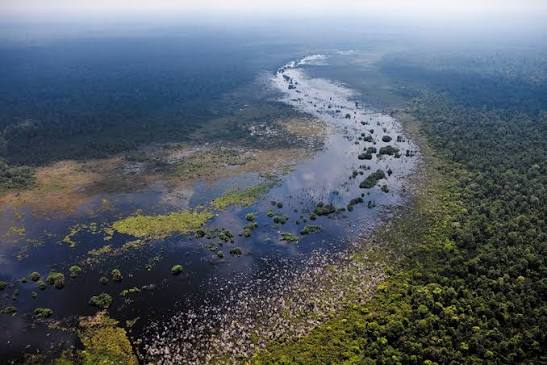
In the Congo Basin, the ground itself is holding an extraordinary secret. Beneath the forests of the Cuvette Centrale lies peat containing an estimated 30.6bn tonnes of carbon. The peat began accumulating about 10,600 years ago; the deposit now covers roughly 145,500 square kilometres.
It is an enormous carbon store.
It is also rather fragile.
Peat is essentially accumulated organic matter kept wet enough to prevent rapid decomposition. Drain the soil and the bargain changes. Carbon that has remained underground for thousands of years can begin returning to the atmosphere. Researchers have warned that the Congo Basin’s peat carbon is vulnerable both to land-use change and to reductions in rainfall.
Africa’s climate problem, then, is not simply that it needs more trees.
It needs to stop destroying some of the infrastructure it already has.
Wetlands are easy to undervalue because they do not resemble infrastructure. There is no ribbon-cutting ceremony for a functioning marsh. No minister can point to a concrete structure and claim credit for water purification, flood regulation or carbon storage.
Yet that is what these ecosystems do.
Kenya’s own numbers make the point. NEMA estimates that the country’s wetlands cover about 4% of its land surface and provide water, food, pasture, construction materials and habitats. Its State of Environment reporting describes wetlands as important to economic activity and notes their role in regulating water and supporting livelihoods.
One estimate is particularly striking. Kenya’s Shompole wetland has been valued at about $2.5bn a year, largely because of water-cleansing services, alongside flood protection and biodiversity benefits.
That figure should change the conversation.
A wetland is not empty land waiting for a more productive use. It is already producing something. The difficulty is that much of what it produces is not bought and sold.
This creates a familiar African policy failure. The private gain from draining, filling or cultivating a wetland can be immediate and visible. The costs are distributed across everyone else, often years later: polluted water, floods, depleted groundwater, lost biodiversity, higher treatment costs.
The developer gets the plot.
The public gets the bill.
Kenya’s environmental authorities have begun trying to reverse that logic. The government has adopted a catchment-based approach to wetland restoration rather than relying solely on isolated projects. Soipan Tuya, then cabinet secretary for environment, climate change and forestry, warned that local restoration could be undone by degradation upstream or downstream. “Wetland restoration that is done at local scale is often negated by degradation upstream or downstream,” she said.
That is less glamorous than planting a billion trees.
It may also be more useful.
Water does not respect county boundaries. Nor does carbon. A wetland cannot be restored effectively while the river feeding it is being polluted several kilometres away. Catchment management therefore forces governments to think about ecosystems as systems rather than collection of politically convenient projects.
South Africa offers another clue. Tuya pointed to its Working for Wetlands programme, which she said had generated 37,000 jobs, mainly for young people and women, over two decades.
Here is where environmental restoration becomes an economic proposition rather than a conservation slogan.
Restoration requires labour. It requires engineering, monitoring, ecological expertise and local management. Done properly, it can generate employment while protecting assets that would otherwise require expensive public investment.
The next question is who pays.
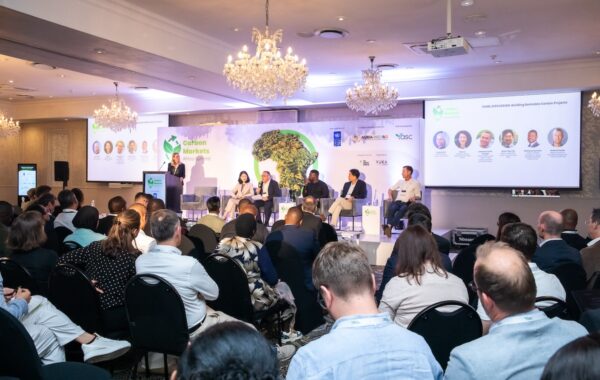
Carbon markets are an obvious candidate. Kenya is already attempting to build a carbon-market framework that the government says should be transparent and have integrity. Tuya said such markets could help finance climate mitigation and adaptation.
But carbon credits are no substitute for good governance.
A wetland project has to establish who owns the land, who has rights to its resources, what would have happened without the project and how much carbon is actually being protected. Measurement is tedious. Verification costs money. Permanence is difficult to guarantee.
Investors may be enthusiastic about nature-based solutions. They tend to become more chary when the underlying asset cannot be clearly measured.
That is fair.
Africa should be equally sceptical of conservation projects whose economics depend on optimistic carbon prices and heroic assumptions about future land use.
There is, however, a larger opportunity.
The continent could begin treating wetlands as natural capital in much the same way that governments treat roads, dams and electricity networks: assets that support economic activity and require maintenance.
The idea is gaining ground. Kenya’s environmental authorities have already mapped more than 10,000 wetlands and are developing restoration and management programmes for them. NEMA’s Adopt-a-Wetland initiative seeks to bring government agencies, companies, communities and other organisations into their conservation.
The Nairobi River offers a particularly revealing case. Wetlands in the capital have been squeezed by construction and other forms of urban expansion. Dik Dik Gardens wetland in Kileleshwa, for example, is among the remaining wetlands in Nairobi and feeds the Kirichwa Ndogo River, which flows into the Nairobi River.
The irony is difficult to miss.
Cities spend heavily trying to control floods and clean polluted rivers while allowing the ecosystems that once performed some of those functions to disappear.
That is not environmental economics. It is accounting failure.
The Congo Basin presents the much larger version of the same dilemma. Its peatlands store an amount of carbon comparable to the above-ground carbon stocks of the entire Congo Basin tropical forests, according to the scientists who mapped them. (Nature)
The deposit is also ancient. Research indicates that peat accumulation began thousands of years ago and that past drying episodes were associated with changes in peat decomposition. More recent research suggests that climate-driven changes in water levels could threaten these carbon stores.
The world’s climate arithmetic therefore contains a nasty asymmetry.
Africa can receive money to preserve carbon. But it can also lose carbon simply because rainfall changes, forests are disturbed or drainage alters the hydrology.
The science does not wait for a carbon-market methodology.
Nor does a flood.
The investment case for wetlands should consequently extend beyond carbon. Water security, flood protection, biodiversity, fisheries, agriculture and tourism all have economic value. Carbon is merely the newest reason to keep the asset intact.
That creates room for more sophisticated finance.
A city could pay to protect an upstream wetland because doing so reduces flood-management costs. A water utility could contribute because a healthier catchment lowers treatment costs. Insurers could have an interest in natural flood buffers. Carbon investors could finance verified emissions reductions. Governments could provide early-stage funding where the public benefits exceed the private return.
The structure would be complicated.
So is a dam.
The difference is that a dam appears on the balance-sheet while a functioning wetland usually does not.
Africa’s climate strategy has spent years searching for new money: concessional finance, carbon finance, green bonds, blended finance and private investment. It should also ask a less fashionable question.
What existing assets are we destroying because nobody has priced them properly?
The answer includes forests. Mangroves. Grasslands. Watersheds. And wetlands.
The Congo’s peatlands make the case at planetary scale. Kenya’s wetlands make it locally, where the consequences are easier to see.
The continent does not need to discover the economic value of nature.
It needs to stop pretending that nature has no economic value until someone puts a price on it.
That may be the more expensive mistake.