Banks still dominate the rally, but capital is spreading into telecoms, energy, manufacturing, consumer stocks and property. The shift could make the NSE deeper; it could also make investors more vulnerable to paying yesterday’s prices for tomorrow’s promises.
By Our Staff Writer
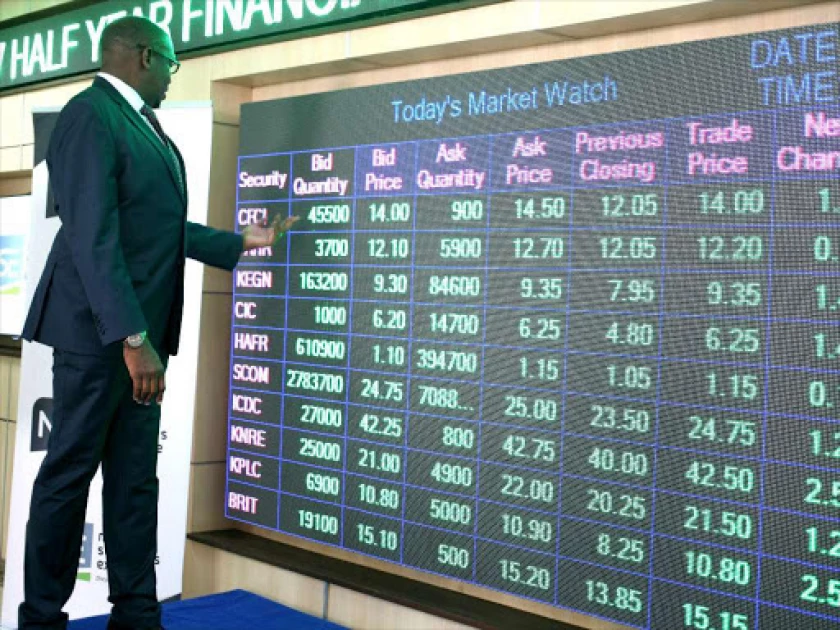
On August 17th the Nairobi Securities Exchange was worth KSh4.05trn. The banking index stood at 279.9, up 3.27 points on the day. More revealing was what was happening underneath those headline numbers: money was beginning to look beyond the market’s familiar giants.
That is the curious thing about Kenya’s equity rally. It began as a repricing of the country’s best-known companies. It is now becoming an argument about what else might be worth owning.
The NSE’s equity market has risen by more than 30% this year, taking its capitalisation to a record KSh4trn, according to Frank Mwiti, its chief executive. Mwiti expects it to reach KSh5trn by December. “My projection is we close the year at 5 trillion,” he told Reuters.
That is a formidable increase for a market whose fortunes have long depended disproportionately on banks and one telecoms company. It also creates a rather awkward question. What happens when investors who have made money in the obvious places begin looking for the less obvious ones?
Banks remain the first port of call
For now, the banks are still where the money is.
The NSE’s banking-sector index has climbed sharply since its launch last year. On July 24th it stood at 265.90, compared with a base of 173.64 on September 1st 2025. By August 17th it had reached 279.90.
The reasons are familiar to anyone who has watched Kenyan banks through several economic cycles: profitable franchises, substantial dividends, falling credit risks and the prospect of renewed loan growth.
The market is also acquiring a new way to express that view. Kenya’s Capital Markets Authority has approved an exchange-traded fund tracking 11 listed banks, allowing investors to buy the sector without choosing between Equity, KCB, Co-operative Bank, NCBA, Absa or their rivals.
That is more significant than it sounds. It turns banking from a collection of stock-picking decisions into an asset class.
But the trade has become crowded. Lower rates should help borrowers and asset quality; they can also squeeze banks’ margins. Investors buying after a substantial re-rating must therefore ask not whether Kenyan banks are good businesses, but how much goodness is already embedded in the price.
The distinction is expensive.
Safaricom is no longer merely a telecoms stock
Safaricom occupies a peculiar position in the market. It is a telecoms operator, a payments company, a financial-services platform and, for many institutional investors, something approaching a domestic infrastructure asset.
Its results explain the affection. Group revenue reached KSh414bn in the year to March 2026 and net income rose to KSh100bn. The company approved a total dividend of KSh2 a share, worth KSh80.13bn, the largest payout in its history.
Peter Ndegwa, Safaricom’s chief executive, described the result as evidence of “strong execution in the first year of our five-year strategy”.
There is another development that matters more for the wider market. Safaricom began offering share trading through M-Pesa in February. Mwiti says the service helped bring about 1m new investors into the market, many of them first-timers.
That changes the constituency of the NSE.
For years the exchange has complained, with some justification, about shallow retail participation and inadequate liquidity. Now millions of mobile-money users can encounter the stockmarket without ever walking into a broker’s office. The consequence could be a more liquid market, but also a more excitable one.
The market, after all, has never suffered from a shortage of opinions.
Energy offers something different
The most striking new arrival is Kenya Pipeline Company.
Its initial public offering in March was the first major Kenyan state-company flotation in almost two decades. The government raised KSh106.3bn, while applications reached 12.49bn shares against 1.8bn on offer, producing a 105.7% subscription rate.
John Mbadi, the Treasury cabinet secretary, described the response as evidence of “strong investor confidence in Kenya’s privatisation agenda”.
Foreign investors were scarcely involved. Domestic and regional capital did the heavy lifting.
That is the important bit.
KPC gave Kenyan investors an opportunity to own a piece of strategic infrastructure rather than another bank or consumer company. If the government continues with privatisation, more such assets could come to market. The attraction for Treasury is obvious: fiscal pressure creates a supply of assets. For investors, however, the question is whether the assets are being sold because they are valuable or because the government needs the money.
Usually, both are true.
Manufacturing gets interesting
Manufacturing has never enjoyed the speculative glamour of technology or the dependable popularity of banking. That may now be its advantage.
East African Breweries, BAT Kenya and other industrial companies offer something investors increasingly prize: established operations generating actual cash. Their problem is that the Kenyan consumer is hardly a limitless source of pricing power. Excise taxes, weak purchasing power and regulation can gouge margins with remarkable efficiency.
EABL is an especially complicated case.
Diageo agreed to sell its controlling stake in the brewer to Japan’s Asahi Group for about $2.3bn. The transaction has since encountered regulatory objections in Kenya, illustrating the premium investors must demand when corporate valuation becomes entangled with public policy.
The wider manufacturing proposition is simpler. Companies that can defend margins, maintain dividends and grow without extravagant capital expenditure may become attractive precisely because they have been overlooked.
In a market rising this quickly, neglect can become a valuation advantage.
Consumers remain the test of the recovery
Consumer companies present the least forgiving version of the rotation.
A rising share price cannot manufacture purchasing power. Kenyan households remain sensitive to food prices, taxes and employment, while companies face the perpetual temptation to raise prices faster than incomes can absorb them.
The strongest consumer franchises are therefore those with brands powerful enough to withstand inflation and excise increases.
This makes the sector a useful test of whether Kenya’s economic recovery is becoming genuinely broad-based. Banks can benefit from financial repricing. Infrastructure companies can benefit from government investment. Consumers eventually have to pay the bill.
If household demand remains tepid, the market will eventually notice.
Property is trying a different trick
Real estate has spent years being more attractive as an idea than as a listed security. The emergence of REITs is changing that.
The NSE’s market statistics on August 17th showed Acorn I-REIT at KSh24.44, with more than 44m units traded since the beginning of the year. Acorn D-REIT stood at KSh29.65, while ILAM Fahari I-REIT was KSh13.80.
The newer proposition is industrial property.
Africa Logistics Properties’ industrial REIT raised $34.55m and was 115% subscribed, giving investors exposure to warehouses and logistics facilities rather than the more speculative end of residential property.
That is a subtle change in the investment proposition. Property becomes less about waiting for land prices to rise and more about buying a stream of rent.
The weakness is liquidity. A property security can produce a perfectly respectable income and still be almost impossible to sell when everyone wants their money back.
The rotation is only beginning
Kenya’s stockmarket is therefore becoming broader without yet becoming broad.
Banks still anchor it. Safaricom remains indispensable. Energy has acquired a new political and financial significance. Manufacturing is being reconsidered; consumer stocks are being sifted rather than swept up. Property is being repackaged for investors who prefer rents to bricks.
The NSE itself is trying to accelerate the process. Its proposed AI-focused ETF, expected before the end of the year, would give Kenyan investors local access to companies with direct exposure to artificial intelligence. “We want essentially to be able to bring a product to our market where the underlying basket is a reflection of companies that have a direct exposure to AI,” Mwiti told Reuters.
It is an odd ambition for an exchange whose traditional pillars are banks, telecoms and industrial companies. But that is precisely the point. The NSE is trying to turn itself from a place where Kenyans trade a small number of familiar shares into a market where different kinds of capital can find different kinds of risk.
The danger is valuation.
Sector rotation sounds sophisticated. Sometimes it is merely a polite description of investors chasing what has already gone up. Banks have risen. Safaricom has recovered. KPC attracted more demand than shares available. New REITs are being launched. The market is febrile.
Yet the more interesting shift is not from one sector to another. It is from a market built around a few dependable names to one in which investors are being invited to price Kenya’s future across a much wider range of businesses.
That future will not be uniformly profitable.
The great test of Kenya’s stockmarket is therefore no longer whether it can rise. It is whether it can broaden without becoming a bigger machine for making yesterday’s winners look like tomorrow’s certainties.