For energy-intensive businesses, rooftop solar can reduce electricity bills and exposure to volatile power costs. But the real return depends on financing, consumption patterns and the cost of keeping the system running.
By Kirimi Mbogo
For a cold-storage warehouse, electricity is not an overhead that can easily be trimmed. Refrigeration must run continuously, temperatures must remain within specified limits, and a power failure can threaten the goods entrusted to the operator.
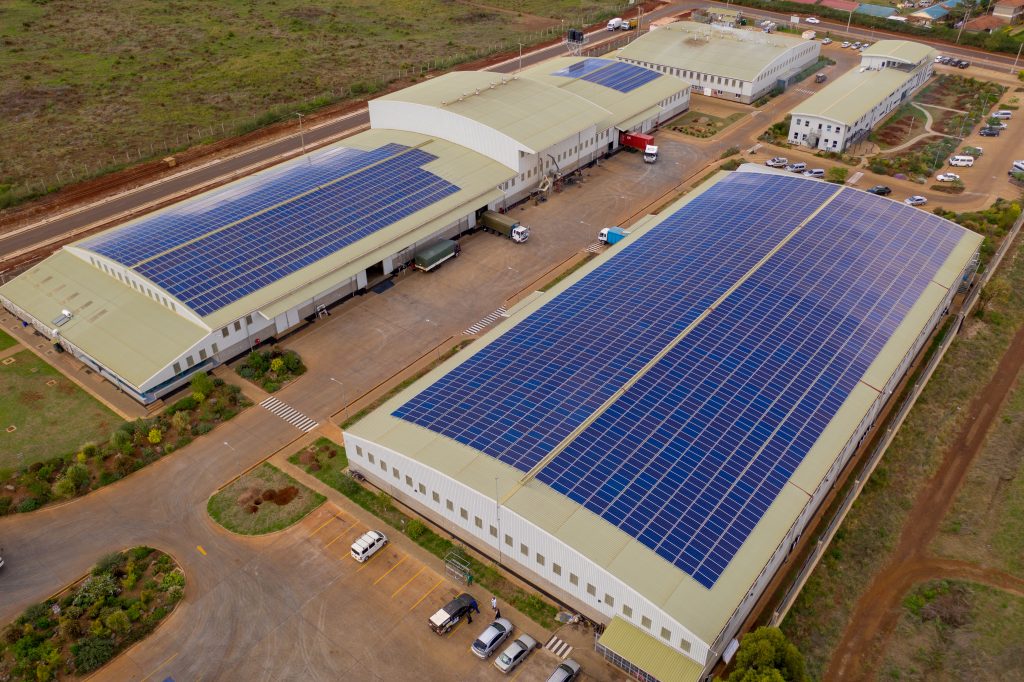
That makes the economics of solar energy particularly important for Cold Solutions Kenya, which operates a temperature-controlled warehouse at Tatu City, north of Nairobi.
The company installed a 1.4-megawatt-peak (MWp) rooftop solar photovoltaic system, commissioned on 30 December 2024. According to project financier Camco, the installation reduced the warehouse’s electricity costs by 24%, saving approximately US$11,000 a month. At an illustrative exchange rate of KSh130 to the dollar, that is about KSh1.43 million monthly, or KSh17.16 million annually, if the reported monthly saving persists.
The project offers a concrete example of how renewable energy can improve a company’s operating economics. Yet its headline saving does not establish the investment’s payback period or total return. Those depend on the installation cost, financing terms, maintenance expenditure and electricity that the system actually displaces.
For Kenyan businesses considering solar, the distinction between a smaller electricity bill and a profitable investment is fundamental.
The economics behind the panels
Cold Solutions operates a 15,000-square-metre warehouse that stores products ranging from fresh produce to meat and pharmaceuticals. Its facility maintains temperatures from 26°C above zero to 40°C below zero, according to Camco’s project account.
Such operations need substantial and predictable supplies of electricity. When demand rises, the additional cost can erode margins. Rooftop solar offers a way to generate some of that electricity on site rather than buy every unit from the grid.
Camco reports that Cold Solutions experienced rising power consumption after commissioning its warehouse in 2023. It subsequently partnered with Ariya Finergy, an energy engineering company, while Camco’s Spark programme provided upfront funding.
The resulting system was designed to supply electricity directly to the facility. Camco describes the installation as a project that cut costs and emissions, with its published case study reporting the 24% reduction in electricity costs.
That is useful evidence of commercial potential, but it comes from the project’s financing partner, not an independently audited assessment of the company’s savings. The underlying electricity bills, total project cost and financing agreement are not disclosed in the public account.
Without them, it is not possible to calculate how quickly the investment will pay for itself.
Financing can determine the return
The initial cost is one of the main obstacles to adopting solar. A business may have a sound long-term case for the technology but still struggle to justify diverting cash from inventory, equipment or expansion.
Spark’s financing model addresses that constraint. Camco says its programme provides businesses with access to energy projects through development partners, including arrangements offering up to 100% upfront financing for eligible installations.
Ariya Finergy, which developed the Cold Solutions project with Spark, describes its services as covering the energy project’s development, installation and ongoing operations and maintenance. Its published company information also identifies commercial and industrial solar, battery storage and power stabilisation among its services.
Such financing can preserve a customer’s working capital, but it does not make solar free. The business must understand what it pays for the electricity or equipment, who bears the risk if generation falls short, and how maintenance and repairs are funded.
An outright purchase ties up capital but gives the owner the benefit of future savings after the initial investment has been recovered. A loan spreads the cost over time while adding interest and repayment obligations. A power-purchase agreement can avoid a large initial payment, but the customer pays for electricity under a contract whose price, duration and conditions determine the eventual benefit.
The right comparison is therefore not simply the purchase price of panels against a monthly electricity bill. It is the total cost of each available arrangement over the period being assessed.
The grid remains the benchmark
Kenya’s electricity tariff structure makes this calculation more complicated than comparing one advertised price with another.
The Energy and Petroleum Regulatory Authority (EPRA) publishes tariffs by customer category and connection voltage. Its FY2024/25 statistics report lists a base energy tariff of KSh13.74 per kilowatt-hour for commercial and industrial customers connected at 415 volts and consuming more than 15,000kWh monthly. The same category carries a demand charge of KSh1,100 under the published schedule. Additional pass-through costs, taxes and levies affect the final bill.
These are historical tariff figures for the stated period, not a current quotation for every industrial customer. They illustrate why businesses should assess their actual bills rather than rely on a single national electricity price.
A factory that consumes most of its electricity during daylight hours may be able to use much of its solar generation as it is produced. A business whose demand peaks at night may gain less from a rooftop installation unless it can shift some operations to daylight or add storage.
This is where the design matters. An oversized system can generate surplus electricity when the business has little immediate demand. The value of that surplus depends on the applicable export arrangements and whether the business can use or store it.
Solar’s commercial value is strongest when the system’s output matches the customer’s demand and displaces electricity that would otherwise have been expensive.
Reliability has a price of its own
Electricity savings are only part of the business case. Unreliable power can interrupt production, damage equipment and disrupt temperature-sensitive storage.
Ariya Finergy identifies power stabilisation as one of its services for commercial and industrial customers, including businesses exposed to voltage fluctuations and blackouts.
That points to a distinction often missed in solar proposals: generating electricity and guaranteeing uninterrupted power are different functions.
A standard grid-connected solar system does not necessarily keep a building running during a blackout. Depending on its configuration, it may shut down when the grid fails. Batteries, suitable controls or a backup generator may be needed to maintain critical operations.
For a cold-storage facility, the value of resilience can be significant, but it must be measured rather than assumed. A company should establish how often outages interrupt operations, which equipment must remain powered and what losses the backup system could realistically prevent.
Battery storage also adds capital and replacement costs. It may improve resilience and allow solar electricity to be used after sunset, but it can weaken the financial case if the additional expense exceeds the value of the electricity and downtime avoided.
What the wider cost evidence says
The broader economics of renewable energy are improving, although global figures should not be mistaken for the cost of a Kenyan rooftop installation.
The International Renewable Energy Agency reported in its Renewable Power Generation Costs in 2024 analysis that 91% of newly commissioned utility-scale renewable-energy capacity worldwide generated electricity at a lower cost than the cheapest newly installed fossil-fuel alternative in the same markets. The global weighted-average cost of electricity from new utility-scale solar photovoltaic projects was US$0.043 per kilowatt-hour in 2024.
IRENA
+1
That comparison concerns large power-generation projects, not the cost of supplying electricity to an individual Kenyan factory. Rooftop installations have different financing, installation, utilisation and operating conditions.
The important lesson is that falling technology costs improve the opportunity, but they do not guarantee that every project will deliver a competitive return.
The cost of capital is particularly important. A business borrowing at high interest rates may find that repayments absorb much of the savings during the early years. A company with a suitable roof, steady daytime demand and access to favourable financing may reach a different result.
Maintenance also matters. Panels require cleaning and inspection; inverters and other equipment may need repair or replacement during the system’s life. Roof repairs, insurance and monitoring can add further expenses.
A credible financial model should include these costs, expected output degradation and realistic assumptions about future electricity prices. It should also test what happens if generation falls below forecasts or the business changes its operating hours.
The test for Kenyan businesses
Cold Solutions demonstrates that a substantial rooftop solar installation can be associated with meaningful electricity-cost reductions in Kenya. Camco’s reported 24% saving is a useful benchmark for further investigation, not a promise that other companies will achieve the same result.
Before investing, a business should compare its existing bills with a technical estimate of the electricity the proposed system will supply. It should then account for installation costs, financing, maintenance, equipment replacement and any additional investment required for backup power.
Management should also distinguish the environmental benefit from the financial one. Reduced emissions may support a company’s sustainability commitments and customer requirements, but those benefits do not automatically translate into lower operating costs.
The most persuasive business case is one that survives a less favourable set of assumptions: lower-than-expected generation, more expensive borrowing, equipment repairs or changes in demand.
For Kenyan companies, the question is not simply whether solar panels can reduce the electricity bill. It is whether the value of the electricity saved, and any demonstrable improvement in reliability, exceeds the full cost of securing those benefits over the system’s useful life.
That is the difference between installing renewable energy and making a sound investment.