
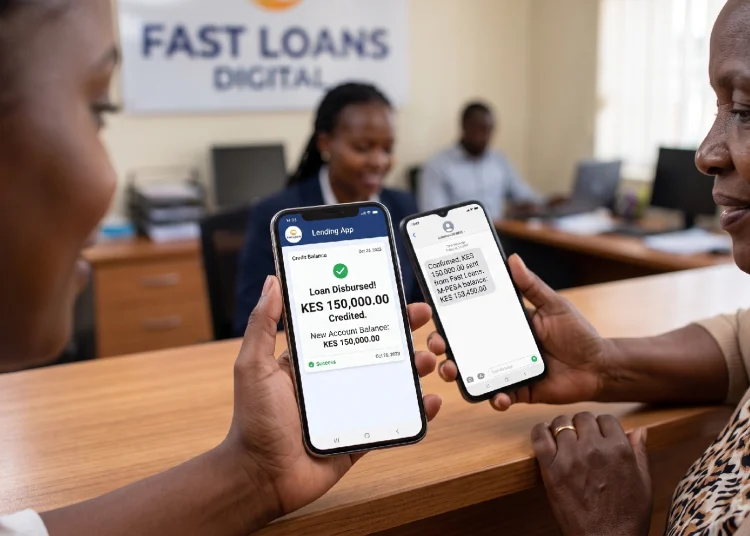
Digital lending is growing rapidly as banks cut borrowing costs and bad loans decline. The contest is shifting towards borrowers who can repay, with banks, mobile-money operators and fintechs competing on price, access and their ability to judge credit risk.
By Our Staff Writer
Kenya’s lenders are facing a different market from the one that emerged during the high-interest-rate period of 2024 and 2025. Borrowing costs have fallen, bank lending is recovering and digital credit providers are expanding. But the competition for customers who can repay remains intense.
The average commercial bank lending rate fell to 14.4% in September 2026, from 17.2% in November 2024, according to the Central Bank of Kenya (CBK). Private-sector credit growth reached 10.6% in September, up from 10.3% in August.
The improvement in lending has coincided with better repayment performance. The ratio of gross non-performing loans to gross loans fell to 13.9% in September 2026, from 14.8% in June and 17.6% in August 2025.
These figures suggest that banks have more room to lend than they did a year ago. They do not mean that credit has become affordable for every household or business. Average lending rates remain high enough to make borrowing costly, particularly for small firms with uncertain cash flows.
For lenders, the task is to expand without repeating the mistakes that left them with large stocks of unpaid loans. For borrowers, lower rates may improve access, but the terms offered will still depend on income, existing debts and credit history.
Digital lenders gain ground
The growth of digital credit providers has been striking. In its 2025 Bank Supervision Annual Report, the CBK reported that their gross outstanding loans rose by 99.6% to KSh110.1bn in December 2025, from KSh55.2bn a year earlier. The number of licensed providers increased from 85 to 195 over the same period.
The expansion continued in 2026. In a July licensing announcement, the CBK said the number of licensed digital credit providers had reached 252. By May, these providers had issued 8.37m loans worth KSh150.56bn. Those figures describe loans granted, not the amount still outstanding.
The numbers show that digital lending is no longer a small corner of Kenya’s financial system. But it remains much smaller than bank lending. Figures presented to Parliament by National Treasury Cabinet Secretary John Mbadi put commercial-bank private-sector credit at KSh4.37trn in December 2025, compared with KSh110.5bn for digital credit providers.
The distinction matters. Digital lenders are growing quickly, but commercial banks still account for most credit extended by these institutions. The competition is not simply a contest in which fintechs are replacing banks. It is a struggle for customers across different types of lending.
The value of the customer relationship
Safaricom’s M-Pesa ecosystem gives mobile-linked lenders a substantial distribution advantage. Products such as Fuliza and M-Shwari allow eligible customers to borrow through services they already use to send money, receive payments and pay bills.
Banks and their partners can use transaction histories, where lawfully available, to assess patterns of income and spending. For a small trader whose business runs largely through mobile payments, those records may offer information that is missing from conventional financial statements.
NCBA’s 2025 results show the scale of this business. The bank reported digital loan disbursements of KSh1.4trn during the year, a 33% increase from 2024.
NCBA Group managing director John Gachora said the bank had completed its previous five-year strategy and was entering its next phase with a stronger business. The report also recorded that digital business contributed 32% of group profitability.
The figures illustrate why established financial institutions are investing in digital channels. They can combine lending with payments, deposits and other services, while reaching customers without relying entirely on branches.
Independent fintechs face a harder financial calculation. Those without access to cheap deposits may depend on commercial credit lines or institutional funding. Their lending rates must cover that funding, technology, collections and unpaid loans. A business that attracts customers quickly can still lose money if too many fail to repay.
Transaction data also has limits. Frequent payments do not necessarily indicate disposable income, and a borrower may have loans from several providers. Lenders still need to assess existing obligations and whether repayments are affordable.
Regulation puts borrowers in view
The expansion of digital credit has brought closer scrutiny. The CBK’s licensing framework was introduced after complaints about high charges, abusive debt collection and misuse of personal information.
In July 2026, the regulator said it had received more than 800 applications from prospective digital credit providers since March 2022. It said licensing assessments covered business models, consumer protection and the suitability of proposed owners and managers.
Licensing raises the cost of operating a lending business, but it also establishes rules for firms handling borrowers’ money and personal information. The challenge is to enforce those rules without closing off responsible credit to people who lack conventional credit records.
Credit reference bureaus have a role in this process. Information on repayment histories and outstanding obligations helps lenders identify applicants who may already be struggling with several loans. It can also help distinguish a borrower who has repaid reliably from one whose record shows repeated arrears.
The information is useful only if it is accurate and lenders interpret it properly. A good record of repaying small loans does not automatically mean that a customer can afford a larger one.
Small businesses remain an opportunity
Small-business lending offers another source of growth. Retailers, distributors and other small firms need money to purchase stock, pay suppliers and cover the time between delivering goods and receiving payment. Many lack the collateral or formal accounts required by conventional banks.
Lenders can assess some of these businesses through sales records, payment histories and supplier relationships. They may also finance stock directly rather than provide cash without restrictions.
That approach can give lenders a clearer view of how funds are used, but it does not remove the risk. Sales can fall, customers can delay payment and suppliers can fail. The quality of the lending decision remains more important than the technology used to make it.
Banks have an advantage in funding and customer reach. Digital lenders may be more willing to serve a narrow group of traders or businesses whose transactions are easy to verify. Both can find room to grow, provided they charge enough to cover risk without placing borrowers under unsustainable pressure.
Can lenders keep growing
The latest figures point to a market that is expanding, not retreating. Bank lending is recovering, average borrowing costs have eased and licensed digital lenders are issuing more loans. Yet the improvement in bad-loan ratios does not remove the need for caution.
The test for banks is whether they can increase lending while keeping defaults under control. For digital lenders, it is whether rapid growth can produce lasting profits after funding costs, operating expenses and unpaid loans are counted.
For borrowers, the important measure is not how quickly a loan arrives, but whether its cost and repayment schedule fit their finances.
Kenya’s lenders are competing for a growing market. The firms that last will be those that understand their customers’ ability to repay, price loans carefully and avoid confusing a rise in disbursements with a healthy lending business.