Unpacking why global metrics favour capital over ingenuity, and how frontier markets are rewriting the rules of economic value
By Kirimi Mbogo
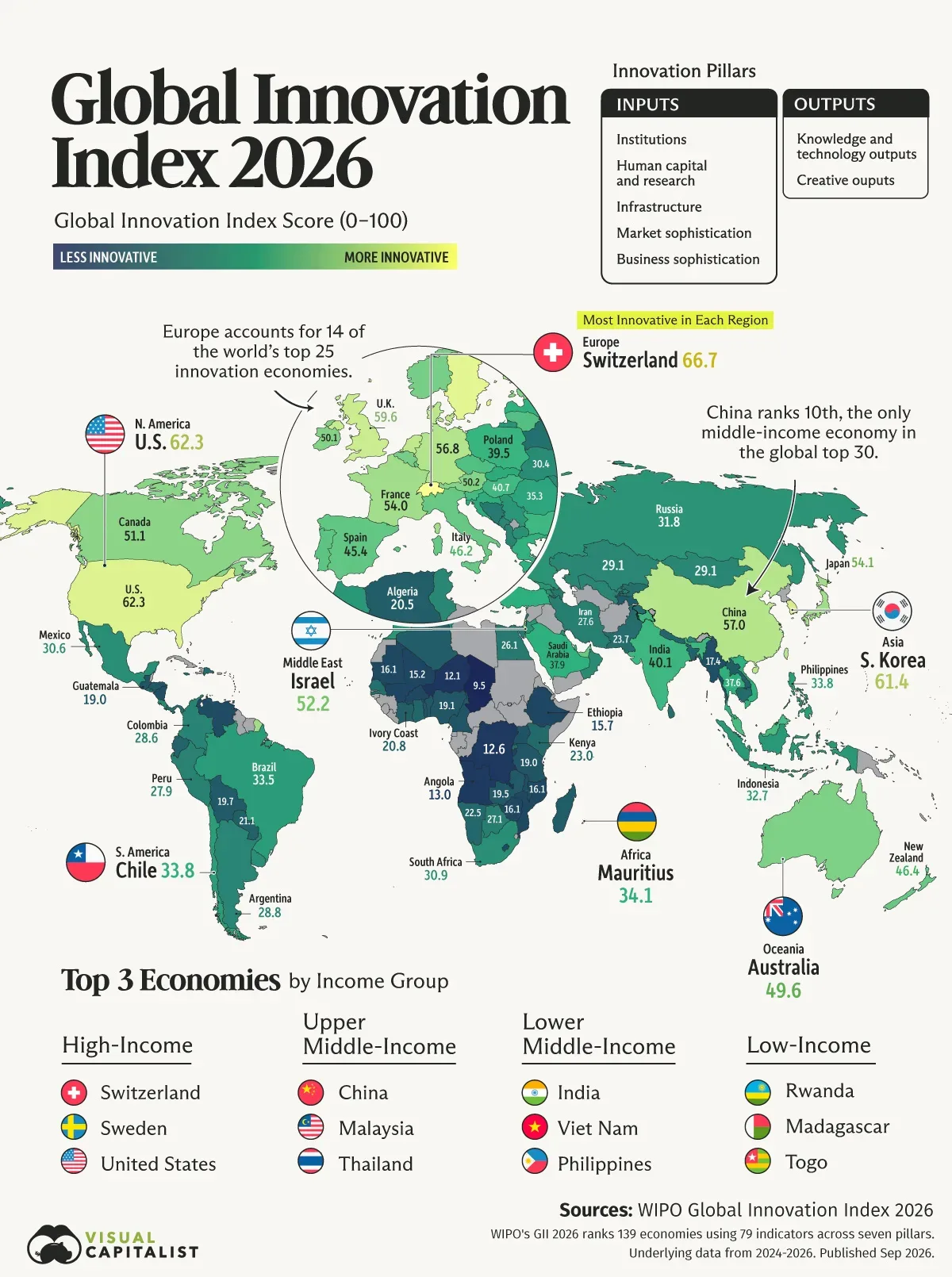
Switzerland remains the world’s most innovative economy, flanked by Sweden and the United States, according to the World Intellectual Property Organization’s (WIPO) Global Innovation Index 2026. For enterprise leaders focused on Western markets, the headline is familiar: Europe and North America continue to dominate the top tier of global research, institutional strength, and patent generation. Yet, looking strictly at Switzerland’s score of 66.7 out of 100 obscures a more pressing economic reality for African markets. Innovation indices are rarely neutral scorecards of ingenuity; they are proxies for capital access, infrastructure density, and commercial scaling capacity. When mapped through an African lens, the 2026 data reveals a continent making incremental structural gains, even as structural funding disparities widen the chasm between frontier economies and global technology heavyweights.
The continental triad
At the top of the Sub-Saharan and broader continental rankings, Mauritius retains its position as Africa’s most innovative economy, placing 50th globally with an overall score of 34.1. It is followed closely by Morocco at 54th and South Africa at 63rd. These jurisdictions illustrate distinct pathways to commercial maturity.
Mauritius utilises its institutional stability, robust legal frameworks, and preferential tax environments to attract financial services and technology-holding capital. Morocco continues to reap the dividends of targeted state-backed industrial policy, automotive manufacturing integration, and heavy infrastructure investments connecting North African logistics to European supply chains. South Africa maintains deep-science research capabilities and market sophistication, though persistent energy constraints and sluggish macroeconomic growth continue to compress venture translation and commercial scaling.
East Africa’s silent engine
Further down the index, East Africa’s primary economic hubs are registering notable momentum. Kenya climbed five places to rank 97th globally out of 139 economies, securing strong metrics in knowledge and technology outputs. Meanwhile, Rwanda emerged as one of the continent’s aggressive upward movers, jumping eight spots to 96th, propelled by centralised digital governance frameworks and targeted incentives for tech-enabled enterprise.
For enterprise decision-makers, these movements reflect sustained investments in digital public infrastructure, mobile-money-led financial inclusion, and a growing density of tech-enabled business models. However, a higher index ranking does not automatically translate into deep-tech commercialisation. While Kenya and Rwanda excel in market adoption and creative outputs relative to their income brackets, translating local software solutions and academic research into globally competitive, capital-intensive intellectual property remains a steep hurdle.
The conversion gap
The fundamental constraint highlighted by the 2026 data across developing markets is not a deficit of human capital or entrepreneurial grit, but the friction of commercial conversion. WIPO’s framework evaluates five input pillars, which cover institutions, human capital, infrastructure, market sophistication, and business sophistication, against two output pillars covering technology and creative outputs. Across emerging and developing markets, capital formation and early-stage ideas are abundant. The structural breakdown occurs in the middle of the economic chain:
Source of Capital → R&D Inputs → THE CONVERSION GAP → Scalable IP → Global Returns
In advanced economies, deep-science startups flow seamlessly from university laboratories into venture-backed scaling ecosystems supported by deep pools of private equity and institutional risk capital. In Africa, risk capital remains heavily concentrated in early-stage fintech or consumer-facing logistics. Long-term, capital-intensive deep tech faces a severe financing drought. Local commercial banks remain risk-averse, viewing early-stage enterprise technology as collateral-deficient, while global venture capital remains cyclical and sensitive to Western monetary tightening. Consequently, local innovators often build resilient businesses that struggle to achieve continental mass without foreign acquisition or relocation of headquarters.
Realigning risk and reward across the ecosystem
The beneficiaries of this landscape are agility-driven regional tech hubs, telecommunications operators pivoting into digital infrastructure, and governments that successfully digitise public services to reduce friction for business formation. The primary economic pressure falls on traditional small and medium-sized enterprises that lack the digital capabilities to integrate automated workflows, leaving them exposed to margin compression as regional markets formalise.
The burden of risk rests on African founders and local institutional investors. They carry the macroeconomic risks of currency depreciation and high interest rates while attempting to build capital-heavy tech infrastructure without deep local secondary markets or domestic pension fund participation in venture asset classes.
Three pressure points to watch next
For policymakers and corporate strategists across Africa, the 2026 rankings serve as both a benchmark and a warning. Looking ahead, three developments will dictate whether continental innovation translates into durable economic growth.
First, observe the mobilisation of domestic institutional capital. The key indicator is whether African regulators can successfully unlock domestic pension and insurance funds, historically locked into risk-averse government securities, to fund local venture capital and infrastructure tech funds. Without local capital backing, the ecosystem remains vulnerable to external macroeconomic shocks.
Second, monitor the implementation of the AfCFTA Digital Protocol. The real test of Africa’s innovation rise will not be global index scores, but how quickly regional trade agreements dismantle cross-border digital and regulatory barriers, allowing tech scale-ups to operate seamlessly across a unified continental market.
Finally, watch for deep-science commercialisation frameworks. Expect targeted public-private models aimed at bridging the gap between university research and commercial enterprise. Innovation leadership in the latter half of the decade will belong less to nations that merely consume imported technologies, and more to those that engineer the structural financial pipelines required to keep home-grown intellectual property rooted within their borders.