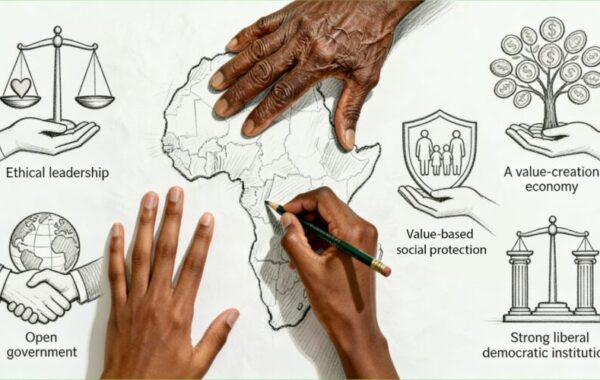
By abandoning minimum balance rules, mandatory payslip verifications, and physical branch constraints, Equity Group Chief Executive James Mwangi turned a failing, technically insolvent building society into East Africa’s pre-eminent financial services engine. In doing so, he fundamentally altered how commercial lenders price risk, structure operating costs, and assess mass-market consumers.
By Kirimi Mbogo
In 1993, Equity Building Society was quietly sliding into oblivion. Operating from a handful of cramped offices in Kenya, the institution was technically insolvent, losing approximately KSh5 million (US$38,000) annually, with non-performing loans consuming over 50 per cent of its credit book. Within the national financial architecture, it sat at the absolute bottom.
“We were ranked number 66 out of 66,” James Mwangi recalled when reflecting on the lender’s early crisis years. “Insolvent, loss-making, and with an audit report that threatened closure.”
At the time, the wider commercial banking sector across Sub-Saharan Africa operated on an exclusive, low-volume, high-margin architecture. Foreign institutions and incumbent Tier-1 domestic banks focused almost exclusively on multinational corporations, state-owned entities, and wealthy elites. For the average low-income citizen, walking into a banking hall was an exercise in systematic exclusion. Lenders enforced steep minimum opening balances, expensive monthly ledger maintenance fees, and mandatory letters of introduction from existing account holders.
Mwangi recalled the deeply personal roots of this exclusion, pointing to how established institutions treated ordinary citizens: “My late mother, Grace, who brought me up, was never allowed to get a bank account. Everybody in my village was not eligible for a bank account.” He realised that this was not merely an administrative hurdle, noting, “You were made to feel that your value to the bank was based on your account balance. The issue of human dignity, the issue of esteem of people—somehow, people felt it was abused. They were rated based on the value of their bank account.”
This institutional wall kept over 95 per cent of Kenya’s adult population completely unbanked. Industry orthodoxy dictated that serving low-income earners, smallholder farmers, and informal micro-entrepreneurs was economically unviable. Conventional risk models assumed that low-income customers lacked financial discipline, that small micro-loans carried unacceptable default risks, and that the administrative cost of processing micro-transactions would overwhelm any bank’s balance sheet.
When Mwangi joined Equity in 1993 as Strategy and Finance Director (before taking the helm as Group CEO in 2004), he looked at this structural exclusion not as a social tragedy, but as a massive market failure hiding a commercially viable opportunity. “I really understood that exclusion from the financial system was exclusion from resource allocation,” Mwangi observed. “That was a turning point.”
Destroying the barriers to entry
Mwangi’s foundational intervention was a single, radical structural decision: to dismantle every operational and economic barrier preventing ordinary citizens from opening a bank account.
In a sector obsessed with physical documentation and bureaucratic screening, Mwangi systematically eliminated the gatekeeping mechanisms. He scrapped minimum balance requirements, abolished monthly ledger fees, and stopped demanding formal pay slips. Where traditional banks required introductions from established customers, Mwangi decreed that a simple government-issued national identity card was sufficient. As Mwangi later explained regarding his operational philosophy: “If the Kenya government has given you an ID, it knows you. Why should a bank demand more?”
To test whether low-income households would respond, Equity introduced the “Ordinary Account”, a low-cost retail option designed for micro-savers. The response sent shockwaves through Nairobi’s banking sector. Queues stretched around the block at Equity’s few branches as market traders, agricultural labourers, and matatu drivers sought account opening forms.
International media and economic analysts quickly took notice of this departure from traditional banking models. The Financial Times noted during Equity’s rapid expansion phase that the bank had “single-handedly rewritten the playbook for financial inclusion in Africa, proving that low-income households are not only bankable, but represent a lucrative market if served at scale.”
Mwangi understood that low-income workers were not inherently credit-unsafe; rather, traditional financial institutions were utilising the wrong tools to measure their economic reliability. Instead of requiring formal land titles as collateral (which few rural Kenyans possessed), Equity pioneered cash-flow-based lending and group-guarantee schemes rooted in community trust networks.
“We realised that these are micro-transactions that happen with a huge frequency,” Mwangi explained. “So we had to create a financial system that overlapped with their lifestyle… We removed the restriction in planning and pushed the planning from being controlled by the bank to the people. Now, they have freedom of choice and control.”
Inverting the unit economics
The critical challenge Mwangi faced was managing unit economics. Serving millions of customers making small transactions threatened to create unsustainable administrative expenses if routed through traditional brick-and-mortar branches.
Traditional banking relied on high average customer balances to generate net interest margins that offset heavy operational expenditure. Mwangi inverted this economic equation by building a high-volume, low-cost platform.
To break free from the capital-intensive cost of building concrete branches, Mwangi pioneered third-party agency banking across East Africa. Equity contracted local shopkeepers, village chemists, and fuel station operators to act as authorised banking agents. Outfitted with point-of-sale terminals, these small business owners handled cash deposits, withdrawals, and account inquiries on behalf of the bank for a small fee per transaction.
“We decided to turn Equity Bank from somewhere you go, to something you do,” Mwangi famously noted regarding the pivot toward agency and mobile distribution.
| Metric / Operational pillar | Conventional banking architecture | Equity’s decentralised model |
| Primary distribution channel | Capital-intensive brick-and-mortar branches | Third-party agent networks and mobile channels |
| Minimum balance requirement | High balance required to offset branch overhead | Zero minimum balance required |
| Primary target audience | Corporate entities and high-net-worth individuals | Mass-market micro-savers and informal enterprises |
| Fee structure | High fixed monthly ledger and account fees | High-volume micro-transaction fees |
| Credit assessment model | Asset-backed collateral and formal payslips | Cash-flow scoring and community guarantee networks |
The economic value chain of this model transformed Equity’s financial trajectory:
The financial model relies on strategic capital allocation, directing capital away from real estate acquisition and toward central technology infrastructure and core digital engines. Third-party agents absorb the real estate, utility, and staffing expenses required for physical cash handling. Local agents earn steady commission income while driving foot traffic to their primary businesses, enabling Equity to achieve instant distribution in deep rural zones without spending capital on branch construction. Millions of daily micro-transactions generate steady fee revenue, aggregating millions of small deposits into a massive pool of low-cost capital.
Speaking at a global financial gathering on the realisation of this mass-market movement, Mwangi reflected: “We dreamt that Kenyans could be banked, we dreamt that everybody could have a bank account, and we have achieved it.”
The regional ripple effect
The commercial success of Equity’s strategy completely upended the competitive dynamics of East African banking. Competitors that had previously dismissed informal sector accounts found themselves losing market share. Legacy banks were forced to eliminate account opening fees, lower minimum balances, and rush to build their own agency networks to stem customer attrition.
Mwangi did not limit this operational model to Kenya. Recognising that underbanked populations were a continental feature, he expanded Equity Group into Uganda, Rwanda, South Sudan, Tanzania, and the Democratic Republic of Congo (DRC).
In the DRC, a market long viewed by foreign lenders as high-risk, Equity acquired Banque Commerciale du Congo (BCDC) and merged it to create Equity BCDC. Applying the same low-cost, mass-market playbook, the subsidiary rapidly became one of the dominant banking institutions in Central Africa.
By mid-2025, Equity Group Holdings had grown from a near-bankrupt building society into a regional financial giant with total assets reaching KSh1.8 trillion (US$13.8 billion) and customer deposits rising to KSh1.32 trillion (US$10.1 billion).
The Wall Street Journal observed during Equity’s cross-border push that “Equity Bank’s model demonstrated that Africa’s informal economy is not a marginal segment to be served by charities, but a commercial frontier capable of driving bank balance sheets to world-class scale.”
Rethinking risk and reward
The broader significance of James Mwangi’s intervention lies in how it redefined risk assessment across emerging markets. By showing that low-income customers maintain high repayment rates when provided with credit products tailored to their cash-flow cycles, Equity forced credit rating frameworks across Africa to adapt.
Industry experts point to Equity’s journey as a pivotal moment in African economic history. Former World Bank officials and regional analysts have noted that Mwangi’s model shifted the policy conversation from social financial inclusion to commercial scale, illustrating that serving the lower economic pyramid could yield attractive return-on-equity metrics for private capital.
Addressing delegates at the Bloomberg Executive Summit on Africa’s economic transformation, Mwangi emphasised that sustainable market growth must be market-driven: “Africa’s next growth chapter will be youth-led, if we provide the right partnerships, the right platforms, and the right financing architecture.”
He elaborated on this broader wealth-creation thesis during an industry forum: “Entrepreneurship provides us an opportunity to turn around our continent. Africa’s biggest challenge is poverty. Entrepreneurs create wealth, and wealth is the cure for poverty.”
Reflecting on the philosophy driving the group’s institutional maturity, Mwangi stated during an investor briefing: “We are a global brand, one of the strongest, not just in valuation but also in global rankings. We are open to partnering with development organisations to fund infrastructure, trade, and other key sectors.”
The next frontier
Having successfully democratised physical branch and agent banking, Mwangi is directing Equity toward its next transformation: full digital integration and cross-border trade settlement. With mobile platforms handling over 90 per cent of total transaction volume, the bank’s operational focus has shifted from physical footprint expansion to digital algorithmic scoring and cross-border supply chain finance.
Outlining his strategic perspective on technological infrastructure, Mwangi noted: “Finance follows infrastructure. If, for instance, we build the digital infrastructure, we unlock access to finance and dramatically reduce the cost of doing business.”
The critical metric for decision-makers and institutional investors to monitor over the coming years is how effectively Equity manages digital credit risk in an environment marked by macroeconomic headwinds and local currency fluctuations. As central banks across Africa tighten monetary policy and raise capital adequacy requirements, Equity’s ability to maintain low non-performing loan ratios across its rapid-fire digital lending apps will determine whether its micro-finance model can withstand changing economic cycles.
What began as an attempt to save a failing building society with 27,000 depositors in 1993 has rewritten the structural foundations of African commerce. By betting on the economic viability of the “unbankable,” James Mwangi did not simply build one of the continent’s largest financial groups; he demonstrated that the true engine of African economic growth resides at the bottom of the pyramid.