A twin hosting strategy for AFCON 2027 and the 2029 World Athletics Championships commits the Treasury to East Africa’s largest public civil works programme. Translating pitch concrete into long-term productivity requires shifting operational control to private commercial managers while embedding stadium investments into a multi-sector tourism engine.
By The Ledger Team
When the Confederation of African Football (CAF) awarded the 2027 Africa Cup of Nations to Kenya, Tanzania, and Uganda under the joint “Pamoja Bid”, the decision was celebrated in Nairobi as a regional diplomatic victory. That momentum expanded significantly when World Athletics selected Nairobi over London and Rome to host the 2029 World Athletics Championships, marking the first time the global track-and-field showpiece will be held on African soil.
Stripped of official ceremony, the twin hosting rights commit Kenya to a massive capital expenditure programme across sports venues, transport links, and municipal systems.
The rationale presented by government officials relies on familiar promises: tourism windfalls, job creation, foreign investment, and an elevated international profile. Yet international economic evidence shows that major sporting events rarely deliver the net financial returns claimed by their promoters unless integrated into broader national commercial frameworks.
The central economic question facing Kenya is not how many foreign supporters will occupy hotel rooms in Nairobi or Mombasa in July 2027. It is whether the public capital committed to these two tournaments can produce self-sustaining commercial assets and tourism loops that generate value long after the athletes and television crews have departed.
The financial outlay
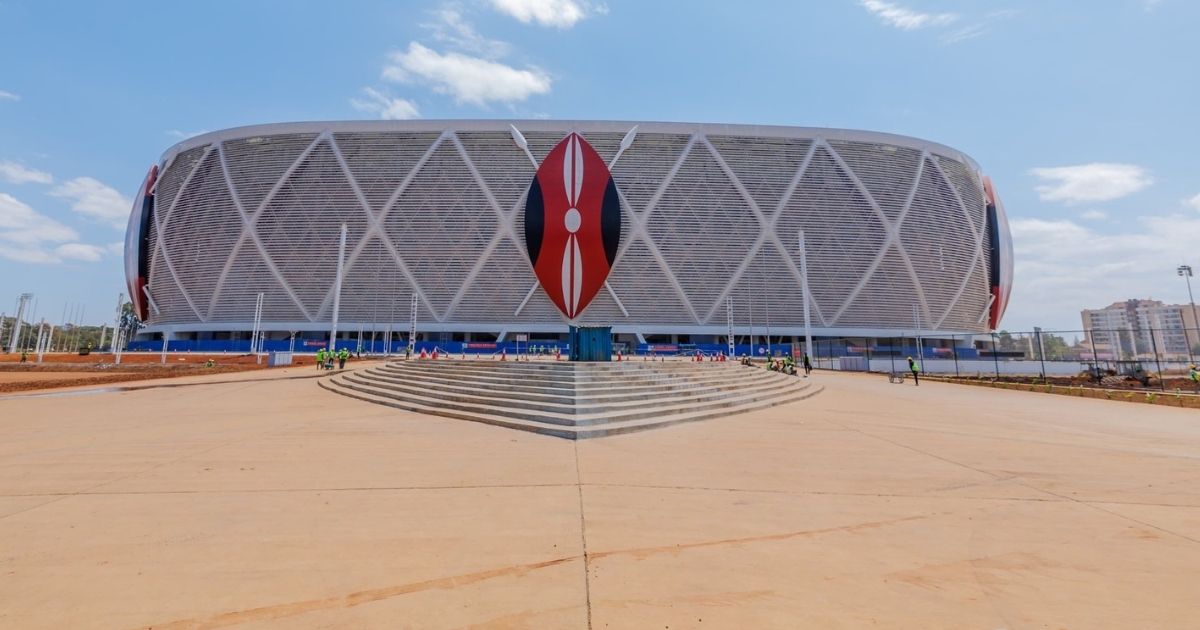
At the core of Kenya’s infrastructure strategy is the construction of the 60,000-seat Raila Odinga International Stadium at Talanta Sports City in Jamhuri Grounds, alongside extensive renovations to the Moi International Sports Centre Kasarani and Nyayo National Stadium.
| Project | Scope of works | Est. cost (KSh) | Est. cost (USD) |
| Talanta Sports City (Raila Odinga Int’l Stadium) | New 60,000-seat arena | KSh45.8bn | $350m |
| Kasarani Stadium renovation | Hybrid pitch, cabling, skyboxes, VIP | KSh4.5bn | $35m |
| Nyayo Stadium upgrade | Acoustics, lighting, media centre | KSh2.5bn | $19m |
| Regional training grounds (Ulinzi, Police SACCO) | Pitch laying, lighting, player amenities | KSh3.0bn | $23m |
| Security and IT infrastructure | Turnstiles, fibre optic, CCTV networks | KSh2.0bn | $15m |
| Total direct venue outlay | Core sports facilities and venues | KSh57.8bn | $442m |
Sources: Ministry of Youth Affairs, Creative Economy and Sports Statements; National Treasury Fiscal Frameworks; Parliamentary Committee Briefings.
Construction at Talanta Sports City is being executed by China Road and Bridge Corporation (CRBC) with engineering supervision from the Kenya Defence Forces. However, the true cost of staging the events extends beyond pitch construction. When accounting for civil works, transport corridors, and Kenya’s KSh3.9bn ($30m) CAF hosting fee, total public expenditure across the two tournaments approaches KSh100bn.
Appearing before the Senate, Cabinet Secretary for Youth Affairs, Creative Economy and Sports Salim Mvurya detailed the government’s fiscal obligations:
“Kenya is supposed to pay KSh 3.9 billion, and we are working with the National Treasury and the relevant Parliamentary Committee to make sure that we comply with our financial obligations. As a government, we know AFCON is going to be a big opportunity because sports is not just entertainment; it is livelihood, it is economic transformation.”
Speaking on the structural legacy of the tournaments, CS Mvurya added:
“One of the reasons why Kenya won the 2029 World Athletics Championship bid is because we are hosting AFCON. Therefore this is a legacy.”
This capital allocation occurs at a delicate moment for public finances. Kenya’s debt-to-GDP ratio hovers around 68 per cent, with debt service absorbing over half of ordinary tax revenue collected by the Kenya Revenue Authority. Every shilling allocated to stadium concrete is capital unavailable for primary healthcare, rural electrification, or agricultural irrigation.
| Fiscal metric | Value / Proportion | Source / Context |
| Ordinary tax revenue allocated to debt service | ~55% | National Treasury / CBK |
| Estimated total event capital expenditure | KSh100bn ($770m) | Treasury & Ministry Estimates |
| CAF hosting compliance fee (Kenya) | KSh3.9bn ($30m) | Ministry of Sports Statements |
| Linzi Finco infrastructure ABS listing (NSE) | KSh44.79bn | Nairobi Securities Exchange |
Sources: Central Bank of Kenya (CBK); National Treasury Quarterly Debt Reports; Ministry of Youth Affairs, Creative Economy and Sports Statements; Nairobi Securities Exchange (NSE) Market Filings.
Expanding the tourism dividend
The primary justification for this public expenditure rests on converting spectator movement into extended consumer spend. The Ministry of Tourism and Wildlife targets an increase in annual international arrivals from 2.4 million to 5.5 million, driving sector revenues towards KSh 1 trillion ($7.7bn). Capturing this value requires expanding tourism models far beyond simple matchday ticket sales.
Direct leisure spillover and multi-destination itineraries
Sports mega-events yield their highest returns when visitors combine match attendance with leisure travel. East Africa’s “Pamoja” hosting model creates direct cross-border travel loops linking urban event sites to primary safari and coastal circuits.
Both host windows align with prime seasonal travel periods. AFCON 2027 runs from June to July, directly overlapping with the annual Masai Mara wildebeest migration. Two years later, the 2029 World Athletics Championships takes place in August and September, capturing the height of the safari season alongside optimal coastal weather.
| Metric / Corridor | Traditional leisure baseline | Projected sports-tourist capture | Operational linkage |
| Length of Stay (Average) | 8–10 days | 12–14 days (extended itinerary) | Match-ticket safari package discounts |
| Nairobi – Coast Corridor | SGR capacity: ~6,000 daily | Dedicated tournament rail shuttles | Standard Gauge Railway (SGR) expansion |
| Circuit Spend / Visitor | ~$1,800 direct spend | ~$2,600 (ticket + park fees + flights) | Single Tourist Visa (EAC) integration |
Sources: Kenya Tourism Board (KTB) Visitor Profile Studies; Kenya Wildlife Service (KWS) Revenue Benchmarks; Kenya Railways Operational Data.
Infrastructure modernisation and non-stadium yield
The capital outlays for AFCON and the 2029 World Championships serve as catalysts for overdue civic and hospitality upgrades.
| Infrastructure area | Targeted upgrades | Strategic tourism yield |
| Aviation Capacity | JKIA expansion, terminal modernisation | Increased long-haul flight slots and regional transfer speed |
| MICE Facilities | High-capacity conference centres (11,000+ seats) | Ability to pitch for global corporate expos post-2029 |
| Urban Transport | Dedicated bus rapid transit (BRT) and corridor upgrades | Reduced friction for Nairobi city tours and cultural visits |
| Hospitality Standards | National hotel classification and quality compliance | Expanded inventory of standardised star-rated rooms |
Sources: Ministry of Tourism and Wildlife Strategic Plan; Kenya Airports Authority (KAA) Master Plan; Tourism Regulatory Authority (TRA).
Economic multipliers, crowding out, and media equity
Proponents argue that initial spending projects trigger broader economic returns through hospitality, transport, and micro-enterprise activity. The Kenya Tourism Board (KTB) projects that AFCON 2027 could bring up to 150,000 international visitors to East Africa, while the 2029 World Athletics Championships could draw another 50,000 track-and-field enthusiasts.
| Category | Estimated share | Primary economic impact |
| Accommodation and hotels | 42% | High local retention |
| Food and foodservice | 22% | Direct SME benefit |
| Aviation and local transport | 18% | Airlines, ride-shares |
| Retail and souvenirs | 10% | Informal vendors |
| Entertainment and safaris | 8% | Secondary tourism |
Sources: Kenya Tourism Board (KTB) Event Impact Modeling; Tourism Research Institute (TRI) Expenditure Studies.
However, economic analysis of major sporting events shows that initial spending projections suffer from two structural distortions: crowd-out effects and capital leakage.
Crowd-out occurs when sports tourists displace traditional business travellers, conference delegates, and safari visitors who avoid Nairobi during peak tournament dates due to room shortages and elevated prices. Capital leakage refers to visitor spending that leaves the host country immediately through international booking platforms and foreign carriers.
Global media valuation and brand equity
The primary long-term return on public capital comes from international media exposure. Broadcast rights for AFCON reach hundreds of millions of viewers, while the World Athletics Championships commands a global television audience spanning 190+ countries, generating an estimated $200m+ in equivalent advertising value (EAV).
By embedding country branding directly into world feeds—similar to the destination strategies utilised by Rwanda and South Africa—Kenya lowers its future customer acquisition costs across European, North American, and Asian source markets.
Benchmarking competitive hub status
Beyond immediate tourism receipts, the state is positioning both events as a global platform to promote Nairobi as a regional commercial hub. Commenting during a venue inspection, Confederation of African Football (CAF) President Dr Patrice Motsepe noted:
“So the world will be coming to Kenya, Africa will be coming to Kenya. It’s also a message of self-belief, a message of confidence in ourselves as Kenyans and as Africans, a moment of pride, a moment of patriotism. We’ve got very high standards in terms of our expectations of the infrastructure, the facilities and the stadiums, the hotels, the roads, the football pitches. We require those facilities to be world class.”
| Metric | Nairobi (Kenya) | Kigali (Rwanda) | Johannesburg (South Africa) |
| 5-Star hotel beds | ~12,000 | ~4,500 | ~28,000 |
| International airport capacity | 12m passengers | 3m passengers | 28m passengers |
| Modern stadiums (30k+ seats) | 3 | 1 | 6 |
| Conferences per year (average) | 110 | 85 | 240 |
Sources: Tourism Regulatory Authority (TRA); International Congress and Convention Association (ICCA) Rankings; Regional Airport Authority Filings.
While international exposure can alter perceptions, foreign direct investment (FDI) depends on structural fundamentals: currency stability, tax predictability, power reliability, judicial efficiency, and port logistics. A well-run tournament demonstrates logistical capability, but it does not lower operational costs for domestic enterprises.
Commercial risk and two-event sequencing
The history of sporting mega-events is littered with financial miscalculations. Host nations frequently underestimate capital costs while overestimating post-event commercial yields.
| Facility | Host event | Initial cost | Annual maintenance cost |
| Moses Mabhida Stadium (South Africa) | 2010 FIFA World Cup | $450m | $6.5m (subsidised) |
| Oyem Stadium (Gabon) | 2017 AFCON | $130m | Neglected / low usage |
| Kasarani Stadium (pre-2024) | 1987 All-Africa Games | $60m (equivalent) | Chronic under-funding |
Sources: eThekwini Municipality Financial Audits; African Football Infrastructure Comparative Studies; Sports Kenya Auditor General Reports.
Talanta Sports City will require between KSh300m and KSh500m ($2.3m–$3.8m) annually in routine maintenance, security, turf management, and structural upkeep. The domestic Football Kenya Federation Premier League (FKF-PL) lacks the ticket yields and attendance figures necessary to anchor a 60,000-seat stadium on a profitable basis.
The two-event advantage
The strategic advantage Kenya possesses over single-event hosts lies in the sequence of its calendar. Securing both AFCON 2027 and the 2029 World Athletics Championships allows the state to amortise its capital investment across two global tournaments within a two-year window.
| Phase | Timeline | Primary focus and operational objective |
| Phase 1 | 2024–2026 | Civil works, Talanta Sports City build, Kasarani modernisation |
| Phase 2 | 2027 | AFCON 2027 staging, operational test, hospitality revenue capture |
| Phase 3 | 2028 | Venue reconfiguration, commercial event testing, MICE hosting |
| Phase 4 | 2029 | World Athletics Championships, track-and-field tourism |
| Phase 5 | 2030+ | Commercial concession era, private leasing, sports academy use |
Sources: Ministry of Youth Affairs, Creative Economy and Sports Inter-Ministerial Master Plan; Local Organising Committee (LOC) Operations Framework.
Regional integration and commercial legacy
By 2030, the branding banners will have been removed, the temporary broadcast gantries taken down, and the international athletic delegations flown home. What remains will determine the ultimate economic verdict on Kenya’s KSh100bn investment.
Regional integration under the EAC
The “Pamoja” framework forces institutional coordination across the East African Community (EAC). Expanding the digital EAC event visa allows for frictionless multi-country itineraries across Kenya, Tanzania, and Uganda. Simultaneously, pushing open skies agreements for regional carriers helps lower intra-EAC flight costs to boost regional leisure travel, while establishing temporary clearance waivers for broadcast and event gear simplifies international logistics.
The commercial legacy roadmap
If these venues are left under the sole administrative control of bureaucratic state agencies, history indicates they will suffer from deferred maintenance, declining usage, and fiscal drain. To prevent this, the Ministry of Youth Affairs, Creative Economy and Sports and the National Treasury must pursue a clear four-part commercial strategy long before 2027.
First, operational management of Talanta Sports City and Kasarani should be handed to experienced international venue operators under long-term private concessions, shifting maintenance risks away from taxpayers. Second, venue designs must ensure flexibility to accommodate trade expos, regional conventions, and major entertainment events without damaging playing surfaces. Third, stadium facilities ought to be integrated directly into Nairobi’s conference circuit, operating arenas as permanent venues for regional trade fairs. Finally, perimeter spaces must be converted into high-performance training centres, sports medicine clinics, and commercial retail facilities that generate year-round rental yield.
Kenya has demonstrated that it can build civil infrastructure when political will aligns with state capital. The harder challenge is managing that infrastructure with commercial discipline once the spotlight fades. AFCON 2027 and Nairobi 2029 offer East Africa a rare opportunity to showcase its economic capabilities to the world. But unless public capital committed today generates self-sustaining commercial returns tomorrow, the legacy of these tournaments will not be a flourishing sports economy, but a collection of costly venues paid for by future generations of taxpayers.