Japanese tech giant expands Nairobi footprint by 50 per cent with new regional hub Multi-million shilling rollout targets lower power demands for grid-constrained markets Regional strategy aims to capitalize on 300-million-consumer trade integration
By Senior Correspondent
NAIROBI — Global technology manufacturer Epson has unveiled a multi-million shilling expansion of its regional operations in Kenya, aiming to use Nairobi as a springboard to capture growing market share across East and Central Africa.
The investment has seen the firm expand its regional head office footprint by 50 per cent to a new 250-square-metre facility. The upgraded site in the Kenyan capital incorporates a dedicated commercial showroom and technical training hub designed to accelerate local capacity building, workforce development and regional distribution networks.
Epson first established its physical footprint in East Africa in 2011, initially relying on distribution partnerships to penetrate regional markets. Over the past decade, the Suwa-headquartered Japanese multinational—which traces its roots to watchmaker Daiwa Kogyo in 1942—has increasingly shifted toward direct regional management as digitalization across Sub-Saharan Africa accelerated demand for office automation and industrial printing.
The expansion comes as global technology vendors look to Kenya as the primary entry point for regional commerce, leveraging its strategic positioning, transport infrastructure and established financial ecosystem. Regional business for the firm has recorded roughly 20 per cent year-on-year growth across commercial printing, scanning and projection systems.
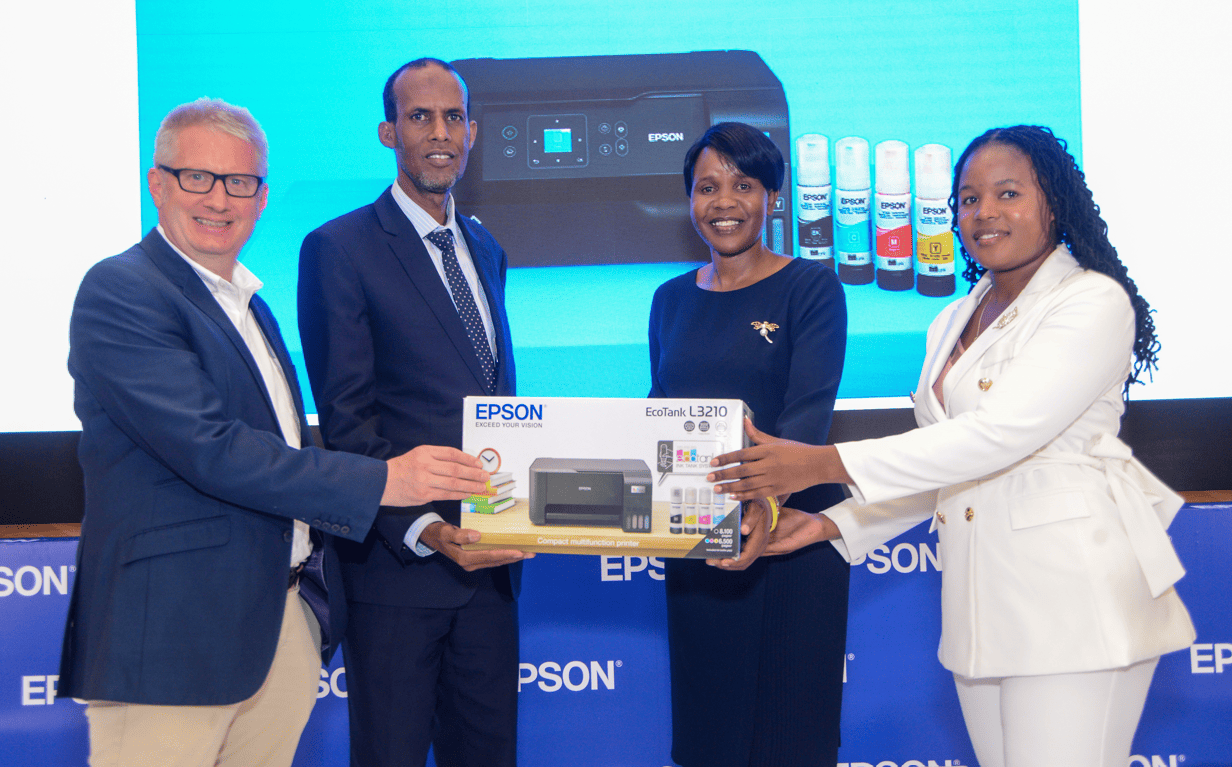
As part of the operational rollout, the company introduced its latest hardware line-up tailored for emerging markets, led by the EcoTank L3350 series.
Speaking during the launch event in Nairobi, an Epson regional representative highlighted the cost and efficiency profile of the new hardware:
“The new printer range that we are launching today includes the L3350… this is one of our champion SKU products. We will have a smaller footprint than what we currently have. It uses ink tanks, it has no moving parts in terms of toners of users, so at the same time we bring affordable printing, low cost of ownership and very little user intervention.”
Energy reliability remains a pressing operational challenge for businesses across East Africa, where grid instability and rising electricity tariffs frequently squeeze operating margins. Addressable hardware features designed to mitigate power constraints featured heavily in the company’s regional product strategy.
“One of the key savings of course is you can power these printers using solar panels. You can use very little energy, they are Energy Star certified, so when they go into standby mode you use as little as 1 watt of energy and replacement parts are minimal.”
The firm emphasized that the architectural design of cold-heat inkjet technology eliminates high-wear internal components typically found in traditional laser alternatives, reducing long-term maintenance overheads for commercial enterprises.
“We do not have a fuser, we do not have a photoconductor unit. These are all elements that need to go into recycling. Using an inkjet printer does not have all these and that is one of the ways that we are, as a company, focused on environment and sustainability.”
The corporate expansion reflects a broader surge in technology investments across the East African Community (EAC), a trading bloc encompassing over 300 million consumers. By establishing a localized training hub in Nairobi, the company plans to upskill regional technicians, streamline after-sales support and support local channel partners across neighboring markets including Uganda, Tanzania, Rwanda and the Democratic Republic of Congo.