A groundbreaking robotic procedure in Nairobi signals a leap forward for regional medical ambition, even as it lays bare the widening structural chasm between elite tertiary care and basic public health.
By Our Reporter
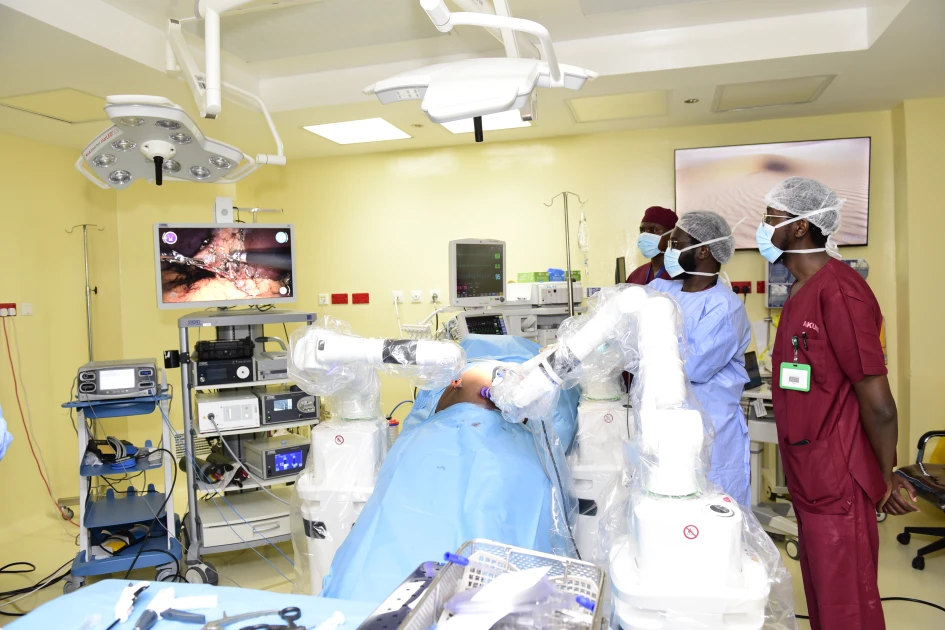
NAIROBI—A three-dimensional image of a human gallbladder, rendered in high-definition optics and projected onto a console screen, is not the usual sight greeting a surgeon in East Africa. Yet at the Aga Khan University Hospital in Nairobi, an operator sitting a few feet from the patient recently used articulated robotic arms to execute a cholecystectomy, the first such procedure performed in the region.
The achievement is being heralded by hospital executives as a transformative moment for African healthcare.
“Since our inception, Aga Khan University Hospital has built a tradition of introducing many healthcare firsts for Kenya and the region. This latest milestone continues that legacy,” said Rashid Khalani, chief executive officer of the hospital. He added that the institution invests in innovation because it enables “safer, precise and evidence-based care for our patients.”
The reality is somewhat more chary. Robotic-assisted surgery is hardly novel in Western capitals, where automated platforms have been slicing through tissue for a quarter of a century. What is remarkable is the sheer audacity of deploying such capital-intensive technology in a healthcare ecosystem where basic diagnostics remain a luxury for millions.
In mechanical terms, the case for robotic interventions is sound. Traditional keyhole procedures rely on rigid, straight-line tools that offer limited dexterity.
“Robotic-assisted surgery builds on the benefits of conventional keyhole surgery by providing surgeons with a three-dimensional view of the surgical field, greater flexibility of movement, and improved access to areas that can be difficult to visualize using traditional techniques,” noted Dr Abdulkarim Abdalla, chair of the hospital’s department of surgery. The robotic arms, he added, “closely mimic the motions of the human hand, enabling greater precision and control during surgery.”
Yet the economics of such apparatuses remain difficult to reconcile; capital expenditure must eventually be recouped. A single surgical robot routinely costs upward of two million dollars, exclusive of service contracts, proprietary consumables, and the extensive retraining of clinical staff. In a private tertiary facility like Aga Khan, these overheads will inevitably feed into patient billing. The procedure risks becoming a boutique luxury for Nairobi’s wealthy elite and medical tourists, rather than a scalable remedy for the continent’s broader health burdens.
Sub-Saharan healthcare often moves along a bifurcated path. Whilst public wards struggle with chronic shortages of oxygen supplies and essential medicine, private medical conglomerates invest in high-margin tertiary infrastructure to capture regional market share. How this divergence will affect long-term equity across East Africa remains an open question, particularly given that the vast majority of surgical conditions across the region are still managed through traditional, open techniques.
For now, the Nairobi milestone represents a triumph of institutional ambition and private capital. The operation demonstrates that sophisticated surgical machinery can function reliably on African soil, providing faster recovery times and less post-operative discomfort for patients who can afford it. Whether such machinery will remain an isolated symbol of prestige or become the catalyst for systemic modernization is a conundrum the market has yet to resolve.