In a city built on the flaunt, Kenya’s richest are learning that the loudest thing money can do now is disappear.
By Our Staff Writer
On the evening of April 9th 2024, at a lifestyle venue called The Social House in Nairobi, a room full of NCBA’s wealthiest clients sat among leather handbags and single malt, and nobody mentioned money. The bags were from Sandstorm Kenya, the whisky from The Macallan; the pairing was deliberate, the branding, mercifully, restrained. Sandstorm’s own account of the evening put it plainly: luxury, in this telling, can be quiet, carried in raw textures and warm tones rather than shouted through logos. No one in the room needed convincing. That was rather the point.
Kenya’s rich are going quiet. Not poor, quiet. A decade and a half ago Nairobi topped a global ranking of the best-performing luxury housing markets, a fact that startled analysts more accustomed to London and Monaco. The city has not grown poorer since. It has grown chary of being watched.
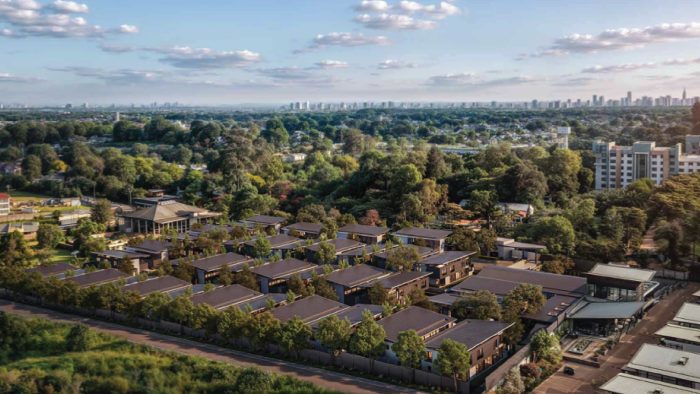
Consider the property market, where the shift is starkest and best documented. Nairobi is densifying: Kilimani, Westlands, stretches of Kiambu Road, all thickening with apartment blocks and their attendant noise. Amid this, developers of a project called “37 BY INEZA”, tucked behind Runda, are selling something Nairobi’s upper tier increasingly wants and increasingly cannot buy at any price: quiet, and the low-density land to put it on. The pitch is not marble or a statement facade; it is, by design, the absence of both. What is being sold, in essence, is negative space, the thing that isn’t there.
This is not new, exactly. It is old money’s oldest trick, imported. Bunny Mellon, the American gardener and heiress who redesigned the White House rose garden, gave an interview to the New York Times in 1969 in which she offered what has become something of a founding text for the genre: nothing, she said, should be noticed. She was talking about flowerbeds. It didn’t matter. The line outlived the garden.
What has changed is who is listening. Kenya’s professional and merchant classes, bankers, agribusiness families, a diaspora returning with foreign salaries and foreign discretion, have absorbed a lesson America’s ultra-wealthy learned watching a television programme about a fictional media dynasty (the imitation, as ever, arrived a full news cycle after the original). Mark Zuckerberg’s uniform of a plain grey shirt did more to popularise stealth wealth than any runway show. As the finance writer Eleanor Pringle put it, high net worth individuals keep their wealth hidden for a range of reasons, from privacy to plain security. Security, in a country where kidnapping-for-ransom and carjacking remain live risks for the conspicuously rich, is not an abstraction here. It is underwriting.
There is a scholarly frame for all this, and it is less flattering than the marketing suggests. The academic Mehita Iqani has argued that extreme wealth is displayed and enacted through spending and consumption, meaning that even the refusal to display is, itself, a form of display, legible only to those fluent in its grammar. A Land Cruiser with no badge polish, a school fee paid without comment, a watch worn face-down: these are not the absence of a message but a narrower broadcast, aimed at a smaller, more discerning audience. Democratic in theory (anyone, allegedly, can wear beige); exclusive in practice, since the beige in question costs what a used car does.
Nairobi’s creative class noticed the mood shift some years before the wealth managers did.
“There’s been a burst of creativity,” the hotelier Shamim Ehsani observed of the city, “Kenyans are coming together in everything from fashion to the arts.” What has followed that burst, in the wealth segment at least, has been a retreat from noise rather than an amplification of it. Sankara’s cocktail terrace and Tribe’s hookah lounge, loud and photogenic in their moment, now read as a previous decade’s fluency. The current register is closer to Angama Mara or Hemingways Nairobi, both marketed, tellingly, on the promise of “quiet luxury in leafy Karen” rather than on thread counts or square footage.
None of this should be mistaken for asceticism. Quiet luxury is not cheaper luxury; often it costs more, since craftsmanship without a label to justify the markup has to justify itself twice, once in materials, once in provenance. A bespoke Sandstorm bag is not a discount alternative to a branded one. It is a different transaction altogether, redolent less of commerce than of membership.
Whether this is a genuine cultural turn or merely fashion cycling back on itself (the term “quiet luxury” is already reported, in some markets, to be losing its grip to louder silhouettes) is a question the data cannot yet settle. Kenya’s version may prove stickier, rooted in security concerns and a wariness of visible wealth in an unequal republic, rather than in a television show’s afterglow. Or it may not; fashion is fickle even when it dresses like it isn’t.
What is certain is this: the era in which a Nairobi businessman announced his arrival with a monogrammed grille and a driver in matching livery is, for a certain class of client, sclerotic, a relic tolerated at weddings and embarrassed everywhere else. The new currency is legibility to the few and invisibility to the many, a form of wealth that (politicians, predictably, still prefer the old kind, for reasons that require no elaboration) asks to be recognised only by those already inside the room. Nothing, as Bunny Mellon might have put it, should be noticed. Increasingly, in Nairobi, nothing is, not by design failure, but by design.