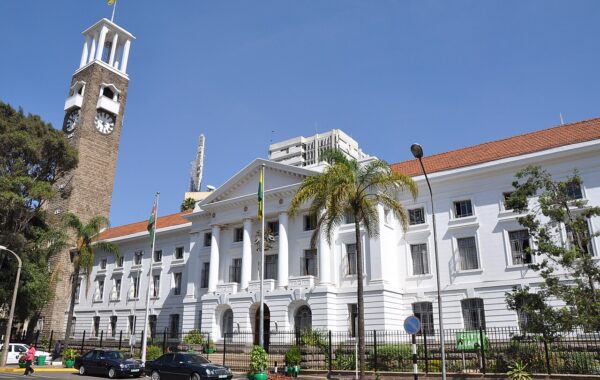

Nairobi has moved business licensing online and bundled its permit, and a national law now promises decisions within 28 days. The charges behind the permit still sit in separate laws, and county inspectors are checking whether businesses paid for the right category.
By Our Staff Writer
Nairobi’s Unified Business Permit has changed where a business pays. It has not changed how many separate charges stand behind the payment. In June the county announced inspections, permit verification and “top-ups” of undercharged permits across all 17 sub-counties. The drive lands on a permit that was sold as simplification.
Governor Johnson Sakaja activated the electronic permit on 1 January 2024, saying it combined the business, fire, food, health and advertising licences. Whether a firm now faces one requirement or several depends on which layer you examine: the law, the invoice or the inspector.
What the law requires
Trade licensing is a county function under the Constitution, so Kenya has 47 separate schemes. The County Licensing (Uniform Procedures) Act was assented to on 28 June 2024 and commenced on 28 December 2024. Each county must set up a licensing board. The Act allows one application for several licences in the same sector, and deems an application allowed if the board has not decided within 28 days. Counties must enable electronic applications within three years, which means by December 2027.
Two limits matter. The reform is one application, not one licence. And it standardises procedure, not fees, which each county still sets in its own finance law.
What Nairobi built
The county’s 2023 Finance Bill proposed a unified permit with a catch: each application would carry the fees for the individual licences behind it, with departments following up on compliance. In January 2024 one trader told The Standard that his combined bill of Sh51,000 was double what he had paid for five separate permits. That is a single account and it is unverified.
The 2026 Finance Act, as summarised by a business-advice site that cites the text, sets trade-licence charges by activity and size. It puts fire charges in a separate schedule under the disaster management law, public-health charges under the revenue law, and signage under the advertising law. The same summary says it does not establish that every charge is bundled into every invoice. Other guides say the permit consolidates trading, fire, health and signage into one fee. These accounts conflict, and I treat the question as unresolved.
Over the Act sits a Tariffs and Pricing Policy for 2025 to 2030. It sets a unit cost of KSh844 per square metre for trade licences, grades businesses from Mini to Hyper by floor area and headcount, and justifies the charge as recovering the cost of services such as firefighting, street lighting and waste collection. The sources I found do not say how the policy and the Act’s schedules interact on an invoice. A policy is not itself a charging law, so this is a question for the county.
An illustration, using the Act’s categories as summarised. A 12-seat café without alcohol falls in the medium eating-house band: KSh25,000 trade licence, KSh10,000 fire charge, and KSh1,000 per food-handler medical certificate. Add the KSh200 application fee and one handler, and the bill is KSh36,200 before signage. That is a calculation from published schedules, not an invoice.
Delay, enforcement and payments are different problems
Delay. The statute offers 28 days. I found no published Nairobi service-charter time for the permit and no before-and-after data. The public mood is sceptical. In the EACC’s 2024 survey, 47.4% disagreed that the time to obtain key services such as licences had fallen, against about a quarter who agreed. That covers all public services, not Nairobi permits alone.
Enforcement. Operating without a valid permit is, in the county’s notice, an offence punishable by a fine of up to KSh50,000, up to three months in jail, or both. Because the fee depends on headcount and floor area, the permit is a self-declaration that inspectors can contest. One guide says inspectors are checking that the category paid for matches the premises. The county’s own notice refers only to top-ups. The risk to a business is reclassification after it has paid.
Informal payments. The EACC survey was fielded from 6 November to 1 December 2024, among 5,960 households, so it predates the Act and says nothing about the reform. Its headline is that 30.5% of people who sought a public service encountered bribery. For business permits its indicators are stark: a bribery prevalence of 77.0% and an average reported bribe of KSh21,466. The county trade department shows 64.0% and an average of KSh3,340.
These figures need care. They are respondents’ reported experiences, not findings against any office or officer. The sections I read do not give the number of permit-seekers behind each indicator, and with 47 counties in the sample the subgroups are likely small. Nairobi’s share of national bribe value was 54.45% in the 2023 survey and 2.03% in 2024, which is a warning against reading county league tables from this source. And 97.2% of those who met bribery did not report it.
The county’s own diagnosis points to a narrower problem. In September the governor told traders that they do not need middlemen and should apply and pay through the portal, and promised verifiable digital identification for enforcement officers within 30 days. A portal can cut out brokers and impostors. It cannot remove an inspector’s discretion over a fire or health finding.
Has the friction moved?
Partly, on the available evidence. A portal removes a counter queue and cash handling. It does not remove the need to classify premises, pass inspections or renew. Nationally the burden is wider than one county’s permit. The Kenya Association of Manufacturers’ March 2026 audit found that some manufacturing sectors need more than 50 licences, permits, fees and charges across national and county governments. The Kenya National Chamber of Commerce told the Senate that duplicative licensing regimes create uncertainty and raise compliance costs.
What cannot yet be said is whether friction fell. Nobody has published time-to-permit or all-in cost data for Nairobi before and after the permit. Three things would settle it. First, whether Nairobi has constituted the board the Act requires and applies the 28-day rule to the permit. Second, whether the county publishes one all-in invoice schedule for each business class. Third, the results of the EACC’s enterprise survey on firms making unofficial payments for permits and inspections. A “single” licence will be proven by the invoice a café owner receives, and that document has not yet been published.