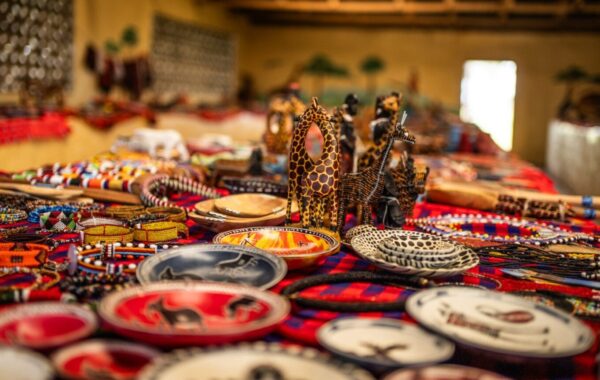

Africa once supplied luxury with its materials and motifs. Now its designers are selling something harder to replicate: the provenance, craft and cultural memory embedded in the object itself.
By Kirimi Mbogo
A Kenyan fashion label has just achieved a distinction that would have been difficult to imagine a generation ago. Yoshita 1967, founded by Anil Padia, has become the first Kenyan brand to reach the final stage of the LVMH Prize for Young Fashion Designers. Its proposition is conspicuously old-fashioned: handwork, small-scale production and collaboration with women-led craft communities. Its ambition is anything but.
The luxury industry has spent decades selling scarcity. Africa has an abundance of it.
Not scarcity of people or raw materials, certainly. Scarcity of the sort that luxury understands: a technique that takes years to learn, a textile whose imperfections certify that it was made by hand, a pattern whose meaning is intelligible only to those who know where it came from. Provenance has become an asset.
This changes the commercial proposition.
For much of the modern luxury era, Paris, Milan, London and Geneva functioned as the industry’s canonical addresses. Africa was more often the source of leather, cotton, precious stones, inspiration and labour than the owner of the finished brand. The value was extracted elsewhere. The invoice followed.
That arrangement is beginning to look rather dated.
African designers are not merely incorporating local motifs into products intended for wealthy foreigners. The more interesting development is the conversion of heritage itself into intellectual property. Craftsmanship becomes a differentiator; ancestry becomes provenance; scarcity becomes production discipline.
And the buyer gets a story that cannot be entirely separated from the object.
South Africa’s Thebe Magugu offers perhaps the clearest example. The designer, who won the LVMH Prize in 2019, has built collections around histories and traditions that are recognisably South African without reducing them to tourist shorthand. His Heritage collections have examined the country’s cultures, motherhood and lobola, the traditional marriage custom.
“I want to show off our culture,” Magugu told British Vogue. “The aim is to celebrate our roots, but what Heritage does is give tradition a modern sartorial spin.”
There is a useful distinction in that sentence. Heritage is not being preserved behind glass. It is being priced.
Magugu has been unusually explicit about the relationship between concept and manufacture. Speaking to the Metropolitan Museum of Art, he said: “I’d hate for the collections to speak a big game while the actual clothes don’t live up to the concept.” For his Alchemy collection, that meant incorporating handwork, beadwork, natural materials and collaboration with practitioners of traditional healing. He also arranged for a percentage of the cost of one garment to go to a healer who had contributed to the work.
That is not corporate social responsibility pasted onto a product after the fact. It is part of the product.
Kenya’s Yoshita 1967 makes the same wager from a different starting point. LVMH describes the Nairobi-based house as an “artisan-led luxury house” built around craft, transmission and collective growth. Its production relies on long-term collaboration with women-led craft communities; the company says training, dignity and stability are part of its model.
The significance of its LVMH recognition is therefore greater than a fashion-industry accolade. It suggests that African craftsmanship is moving from the supply chain to the brand proposition.
That is where the money is.
Africa’s fashion industry remains fragmented and dominated by small enterprises. UNESCO has estimated the continent’s fashion economy at nearly $6bn in 2022, while noting the concentration of high-fashion activity in countries including Kenya, Nigeria, Ghana, Rwanda, Senegal, Côte d’Ivoire and South Africa.
The figures are modest beside the global luxury business. The strategic opportunity is not.
Luxury has always depended on an apparent contradiction. The company wants growth; the customer wants exclusivity. The factory wants efficiency; the buyer wants evidence of the hand. Shareholders prefer scale; desirability often prefers constraint.
African brands may find that their historic production disadvantages become part of their competitive advantage, provided they can prevent the economics from becoming punitive.
A garment made by a small network of artisans cannot be reproduced at the speed of a mass-market factory. Nor should it be. The irregularity of a handwoven textile, the variation in beadwork and the fingerprints of its maker are precisely what industrial production is designed to eliminate.
In luxury, imperfection can be expensive.
The same principle extends beyond fashion. Ghanaian kente, Nigerian aso oke, Malian bogolanfini, Ethiopian weaving and South African beadwork all embody systems of knowledge that predate today’s luxury houses by centuries. Their value lies not simply in appearance but in the accumulated cultural information carried by the technique.
The V&A has documented the way African textiles have historically conveyed identity, status and storytelling, with skills transmitted between generations.
What is changing is the willingness to attach a premium to that inheritance.
Hospitality is discovering the same logic. So are interiors, jewellery, furniture and gastronomy. A safari lodge can sell scenery, or it can sell an interpretation of place that could not be reproduced in another country. A hotel can import European furniture, or commission objects whose materials and making belong to the region. A jewellery house can sell precious metal, or the cultural meaning attached to its form.
The second proposition is harder to copy.
It is also harder to fake.
That matters because the global appetite for African design carries a peculiar danger. “African” can become a lazy category, compressing dozens of countries, languages and traditions into a single decorative aesthetic. The result is a familiar form of extraction: take the motif, manufacture elsewhere, sell it back at a premium.
Luxury brands will need to demonstrate provenance rather than merely announce it.
The distinction is becoming commercially important. Consumers accustomed to checking whether diamonds are conflict-free are increasingly interested in who made their clothes, where materials came from and whether communities represented in a campaign received anything more than exposure.
Magugu’s work again provides a useful model. He has described his brand as a kind of encyclopedia of histories that risk being forgotten. “I want the brand to function almost like an encyclopedia of those hidden gems,” he told the Met, “that might otherwise run the risk of being forgotten.”
That is a rather more durable proposition than “African-inspired”.
The investment opportunity is consequently not limited to designers. It includes the workshops, textile producers, logistics firms, financiers, intellectual-property specialists and training institutions required to make artisanal luxury commercially viable.
This is where African governments have less glamorous work to do. Better protection of designs and cultural property would help. So would reliable power, export logistics and access to patient capital. Fashion weeks make better photographs, but factories and intellectual-property registries make better industries.
Politicians, predictably, favour the photographs.
There is also the question of scale. The moment a craft becomes fashionable, demand can overwhelm the communities that sustain it. Artisans may be asked to produce more quickly, cheaper and in larger quantities. Quality falls. The cultural meaning gets diluted. The brand then discovers that the thing it was selling has disappeared.
Luxury’s oldest trick is scarcity. Africa’s challenge will be preserving it without turning artisans into props.
Taken together, the developments point to a broader shift in the economics of African creativity. The continent has spent generations exporting commodities and importing finished goods; in luxury, at least, the possibility is emerging of exporting finished ideas, brands and cultural capital.
The distinction is crucial.
Africa does not need to persuade the world that its heritage is interesting. It needs to persuade the market that heritage has a price, that its makers should capture a meaningful share of it, and that the finished object is worth waiting for.
Yoshita 1967’s appearance among the 2026 LVMH finalists is an early signal. Magugu’s rise is another. Neither proves that an African luxury industry has arrived. It does suggest that the old geography of luxury is becoming less certain.
For centuries, the world’s luxury houses sold rarity.
Africa is beginning to sell something rarer still: things that have a provenance the factory cannot manufacture.