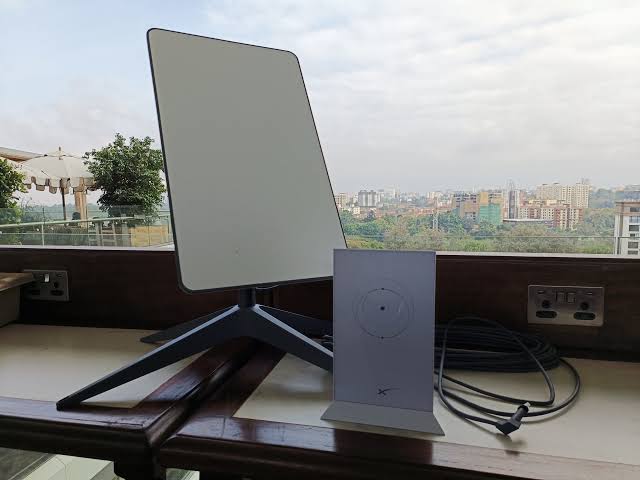
A KSh2,500 monthly discount may not sound like much in a country where the cost of living is discussed in larger denominations. For Starlink, however, it marks a rather more consequential bet: that satellite broadband can move beyond the affluent early adopter and become an ordinary household utility.
Starlink has introduced Residential Lite in Kenya at KSh4,000 a month, compared with KSh6,500 for its standard Residential service. The cheaper plan offers download speeds of up to 200 Mbps, according to Starlink’s Kenyan website, though the company is careful to qualify that figure. It is a 90th-percentile speed, not a promise. Congestion can make it slower.
That distinction matters.
The economics of Kenyan broadband have long been governed by a fairly mundane constraint: fibre is excellent where fibre exists. Outside the better-served parts of cities and towns, it can be another matter. Mobile networks fill some of the gap, but coverage, reliability and the cost of large data bundles remain awkward propositions for households and small businesses operating at the edge of the formal economy.
Starlink was built for precisely this sort of inconvenience. Its low-Earth-orbit satellite network can reach places where laying fibre or extending terrestrial infrastructure is unattractive. Kenya is already one of the African markets in which the service operates. The new price suggests that Starlink now wants more customers, not merely more headlines.
The company describes Residential Lite as suitable for ordinary household use, including streaming, video calls, working from home and general browsing. Its support material says typical download speeds for the 200 Mbps service can range from 80 Mbps to 200 Mbps, with upload speeds of 15 Mbps to 35 Mbps; data is unlimited, but users on the cheaper tier can experience slower speeds at busy times.
This is where the arithmetic becomes interesting.
Residential Lite is about 38% cheaper than the standard Kenyan plan. For a household paying KSh4,000, the annual subscription comes to KSh48,000, against KSh78,000 for Residential. The saving is KSh30,000 a year. That is enough to turn Starlink from a novelty for relatively prosperous households into a more plausible proposition for small enterprises, rural professionals and families whose alternatives are poor.
There is, naturally, a catch. There usually is.
The KSh4,000 is the monthly service price, not a declaration that connectivity has become cheap in every sense. Customers still need Starlink equipment, and the service remains dependent on the economics of a satellite network rather than a buried cable. Performance can also deteriorate during periods of congestion. Starlink itself says that its advertised speeds are maximum available speeds and are not guaranteed.
For Kenya’s established internet providers, the more interesting question is not whether Starlink will replace fibre. It will not. Fibre remains difficult to beat in dense urban areas where networks already exist and demand is predictable.
The contest is elsewhere.
Starlink can make the economics of serving scattered customers less punishing. A household several kilometres beyond a fibre footprint looks expensive to a conventional network operator because the last mile has to be built. To Starlink, the last mile is largely a matter of pointing hardware at the sky. The technology is expensive in its own way, but the marginal geography is different.
That could matter for education, remote work and small businesses. A consultant in a rural town, a lodge outside a major centre or a farmer running cloud-based systems does not necessarily need a telecommunications network designed around urban density. He needs a connection that works.
Starlink is betting there are enough such people.
The company’s wider ambition is visible in the numbers. Its Kenyan site says the service is available in more than 160 countries, territories and other markets, while its product range now extends from fixed residential connections to portable services.
The KSh4,000 plan therefore looks less like a promotional discount than a piece of market segmentation. Those willing to pay KSh6,500 can retain the higher-priority residential service. Those who are more price-sensitive get a cheaper tier, accepting slower performance when demand rises. It is a familiar airline trick, transported into the sky.
For Kenyan consumers, that is probably good news. Competition has a way of concentrating the mind, even when the competitor arrives from orbit.
The harder question is whether lower monthly prices can produce enough additional demand to justify the economics of the network. Starlink has made the first move. What the Kenyan broadband market does with it is still being written.