Digital platforms, regional integration and a more discriminating pool of global capital are changing who gets to set the terms of business
By The Ledger Team
In a Nairobi office, a merchant can now accept payment from a customer she has never met, finance inventory from a lender several hundred kilometres away and sell the resulting goods across a border without opening a branch. The transaction may take seconds. The competitive consequences take longer to register.
Africa’s markets are being rewired.
For decades, competition was largely a contest between firms that owned things: factories, shops, trucks, telecoms towers, bank branches. Market power accumulated through scale and distribution. The new contest is less tangible. It is over platforms, data, payment rails, logistics, software and access to customers. Whoever controls the junction through which transactions pass can exert influence far beyond the product he sells.
That is why the old question, “Who has the biggest market share?”, is becoming an inadequate one.
Consider Kenya’s mobile-money market. Safaricom’s M-Pesa became so deeply embedded in daily commerce that its importance ceased to be confined to payments. Researchers Anthea Paelo and Simon Roberts describe dominant mobile-money platforms as possessing substantial market power and the ability to act as “gatekeepers”. The World Bank has similarly documented concerns about Safaricom’s use of its position across adjacent financial and digital services.
The lesson is broader than Kenya. Digital markets tend towards concentration because the largest platform attracts the most users, which attracts more merchants, which produces more data, which makes the platform harder to dislodge. A virtuous circle for the incumbent; a rather less virtuous one for the entrant.
Africa’s competitive battleground is therefore moving from ownership to orchestration.
The distinction matters. A supermarket that dominates a town can raise prices, but eventually customers can shop elsewhere. A platform that controls payments, identity, data or distribution can influence the conditions under which rivals reach those customers in the first place. Competition becomes less about the price of the thing and more about access to the pipes through which the thing travels.
Regulators are beginning to notice.
The AfCFTA’s competition and digital-trade architecture reflects a growing determination to prevent continental integration from becoming an open invitation to digital gatekeepers. Academic research published in the German Law Journal notes that African jurisdictions, including South Africa and Kenya, are increasingly adopting pro-competitive rules aimed at digital markets, while the AfCFTA Competition Protocol contains obligations intended to make it easier for smaller players to enter and compete.
That is a significant change in temperament. Competition policy was once largely about stopping firms from abusing existing dominance. Increasingly, it is about designing markets in which dominance is contestable before it becomes permanent.
Politicians, predictably, prefer the latter formulation when it comes with a ribbon.
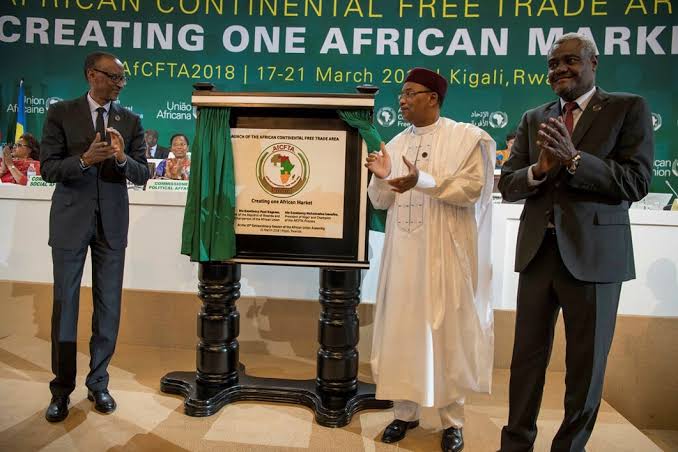
Regionalisation is supplying another source of competitive pressure. The African Continental Free Trade Area is intended to turn a collection of relatively small national markets into something closer to a single commercial arena. That matters because many African firms have never had a domestic market large enough to justify the capital expenditure required for serious industrial scale.
A manufacturer in Ghana competing only in Ghana faces one set of economics. The same manufacturer selling into Nigeria, Côte d’Ivoire, Senegal and Kenya faces another. The fixed costs of technology, branding and distribution can be spread over a much larger customer base. So can mistakes.
Yet regionalisation does not automatically produce competition. It can produce larger incumbents instead.
The difference lies in the rules governing market access. If customs procedures remain cumbersome, payments cannot move easily across borders and digital identities are incompatible, the theoretical continental market remains just that. A UNDP study of digital marketplaces in Ghana and Kenya found that only one platform in each country among those mapped facilitated cross-border transactions. (UNDP) The problem is not a shortage of entrepreneurs. It is the friction between them.
Wamkele Mene, secretary-general of the AfCFTA Secretariat, put the problem more bluntly in 2026: “Africa has never lacked enterprise. It has lacked infrastructure equal to its ambition.”
Capital is changing the equation too.
Africa attracted about $70bn in foreign direct investment in 2025, according to UN Trade and Development. That was below the exceptional $94bn recorded in 2024, but still the third-highest level since 1990 and roughly one-third above the continent’s long-term average. More revealing than the headline total is where the money is going. Energy, infrastructure, logistics, critical minerals, artificial intelligence infrastructure and advanced manufacturing are attracting investors seeking strategic assets rather than merely cheap labour.
The implications for competition are awkward.
Capital does not merely follow markets. It can create them. A well-financed entrant can buy distribution, subsidise customer acquisition and endure losses long enough to displace a complacent incumbent. Equally, a foreign investor can acquire an already dominant company and make concentration worse.
Africa therefore faces a peculiar conundrum: it needs more capital, while becoming more chary about the terms on which that capital arrives.
The distinction is becoming especially important as Gulf and Asian investors expand their presence. UN Trade and Development says investors from the Gulf and other Asian economies are becoming increasingly important sources of greenfield investment in Africa, particularly in energy, logistics, real estate and infrastructure. Competition for African assets is no longer simply a contest among Western multinationals.
That gives African governments more bargaining power, at least in theory.
But bargaining power is useful only when institutions can wield it. A regulator confronting a global technology company with deeper pockets, better lawyers and more engineers may possess statutory authority without possessing equivalent practical power. The gap between legislation and enforcement is where many grand African reforms have gone to die.
Kenya’s experience illustrates both the promise and the problem. Its competition authorities have intervened in mobile-money arrangements and scrutinised digital markets, while proposed reforms seek to address newer forms of market power. South Africa has undertaken an Online Intermediation Platforms Market Inquiry. The AfCFTA framework seeks a continental response.
Taken together, these measures suggest a new conception of competition policy: not merely preventing gouging, cartels and exclusion, but preserving the possibility that the next African firm can become large without first becoming someone’s acquisition target.
That possibility matters because the geography of African enterprise is itself changing. Venture capital remains concentrated in South Africa, Nigeria, Kenya and Egypt, according to the African Development Bank. Yet African startups that reach later funding rounds have shown considerable competitiveness: median Series B and Series C deals in 2024 were $29m and $38m respectively, above global averages cited by the bank.
The winners will not necessarily be the firms with the cheapest labour or the largest factory. They will be those able to combine data, capital and regional reach before their competitors do.
And there is the rub.
A fragmented continent creates small markets; small markets encourage concentration; concentration creates incumbents; incumbents then acquire the very firms that might have challenged them. Digitalisation can break that cycle, but it can also accelerate it. AfCFTA can enlarge the prize, but without interoperable systems and credible enforcement it may simply enlarge the incumbents’ hunting ground.
Global capital introduces the final complication. Investors are becoming more selective, and strategic. They want exposure to Africa’s energy transition, critical minerals, infrastructure and digital growth, but they increasingly want bankable projects and credible exits. African Development Bank president Sidi Ould Tah has argued that the continent faces an annual development-financing gap of about $402bn and that public resources alone cannot close it. “Africa’s development cannot be financed by public resources alone,” he said.
Quite.
The new rules of African competition will therefore be written in three places at once: in the code governing platforms, in the protocols that make borders cheaper to cross, and in the investment contracts that determine who owns the infrastructure underneath the new economy.
The old competitive advantage was scale. The next one may be interoperability.
For governments, that means resisting the temptation to confuse an African champion with a protected champion. For companies, it means that regional reach, trusted data and control of distribution may matter more than a handsome balance-sheet margin. For investors, the prize will belong to those able to see where regulation is heading before the lawyers do.
Africa’s market power is shifting. The question is not whether it will move. It is who will be standing on the other side of the transaction when it does.